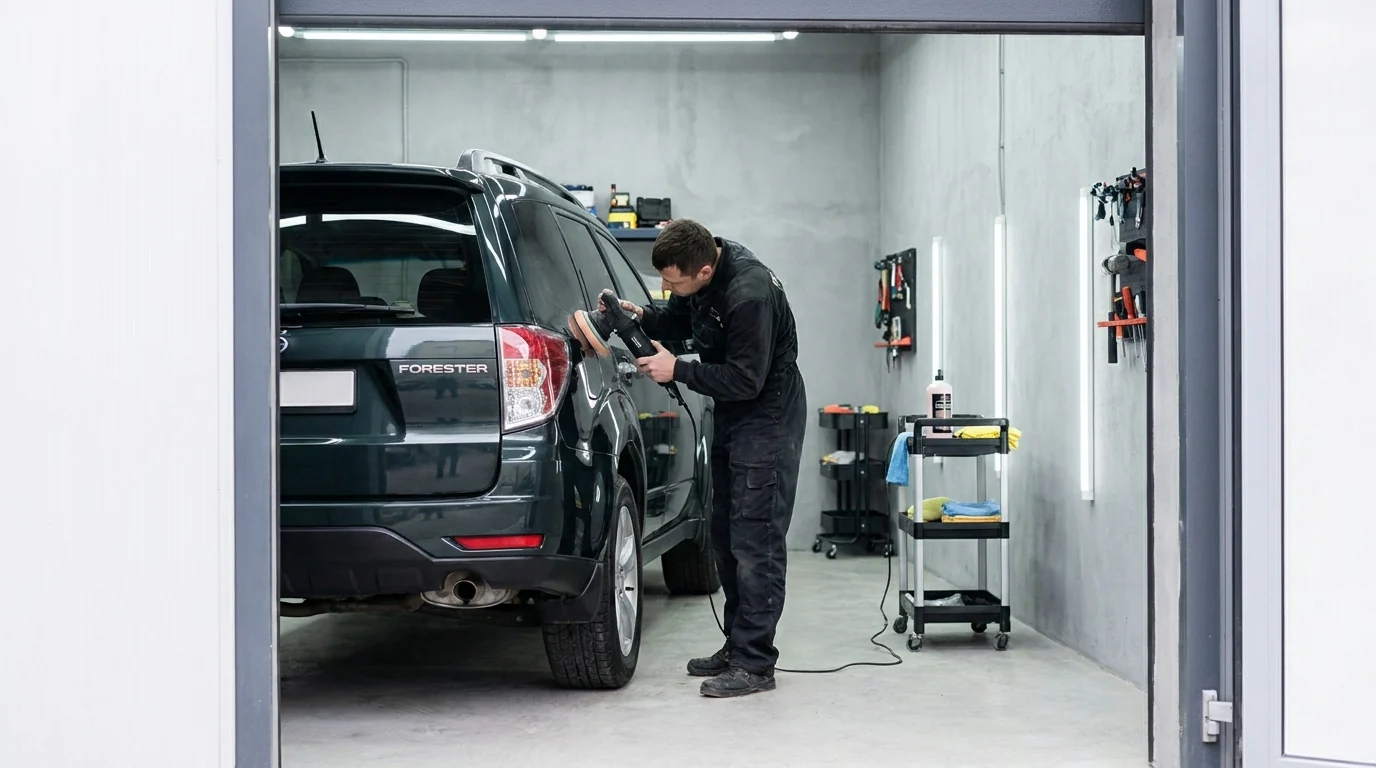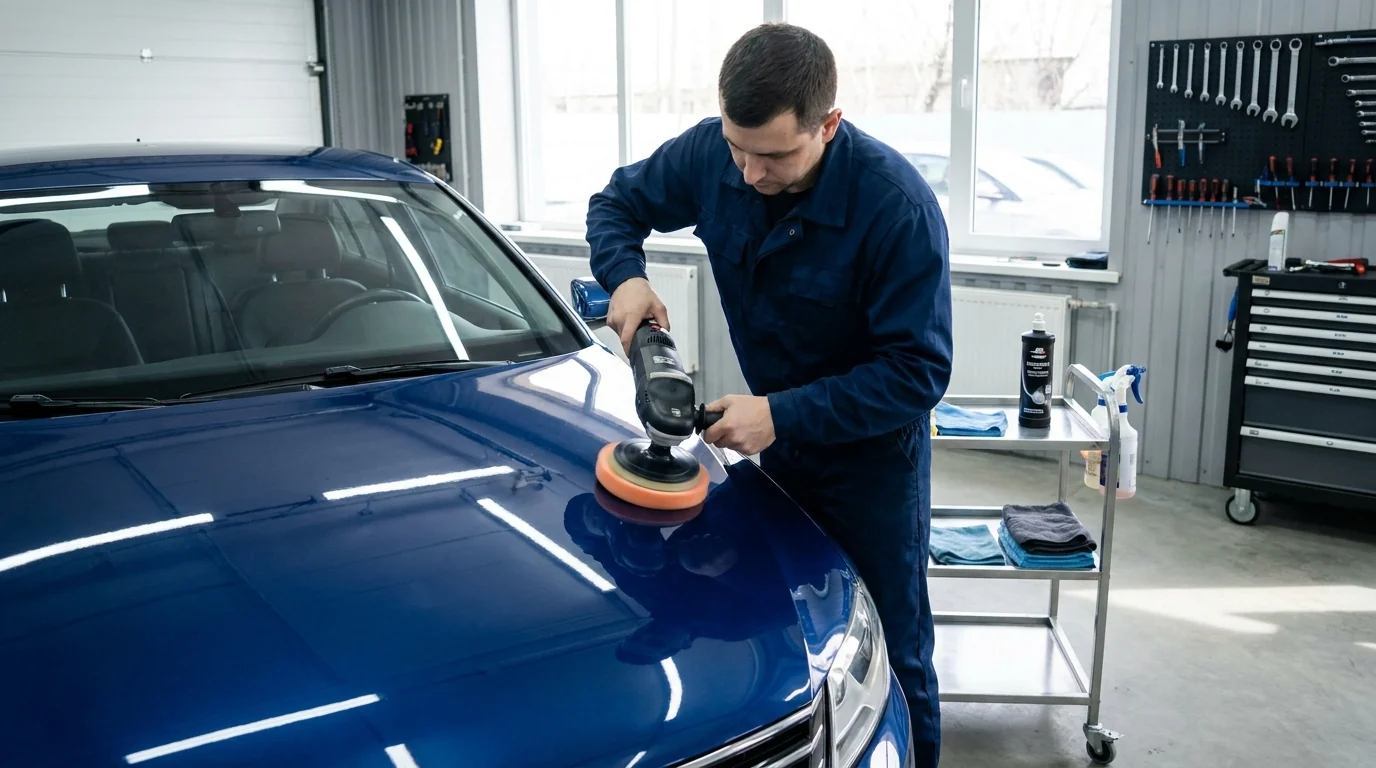
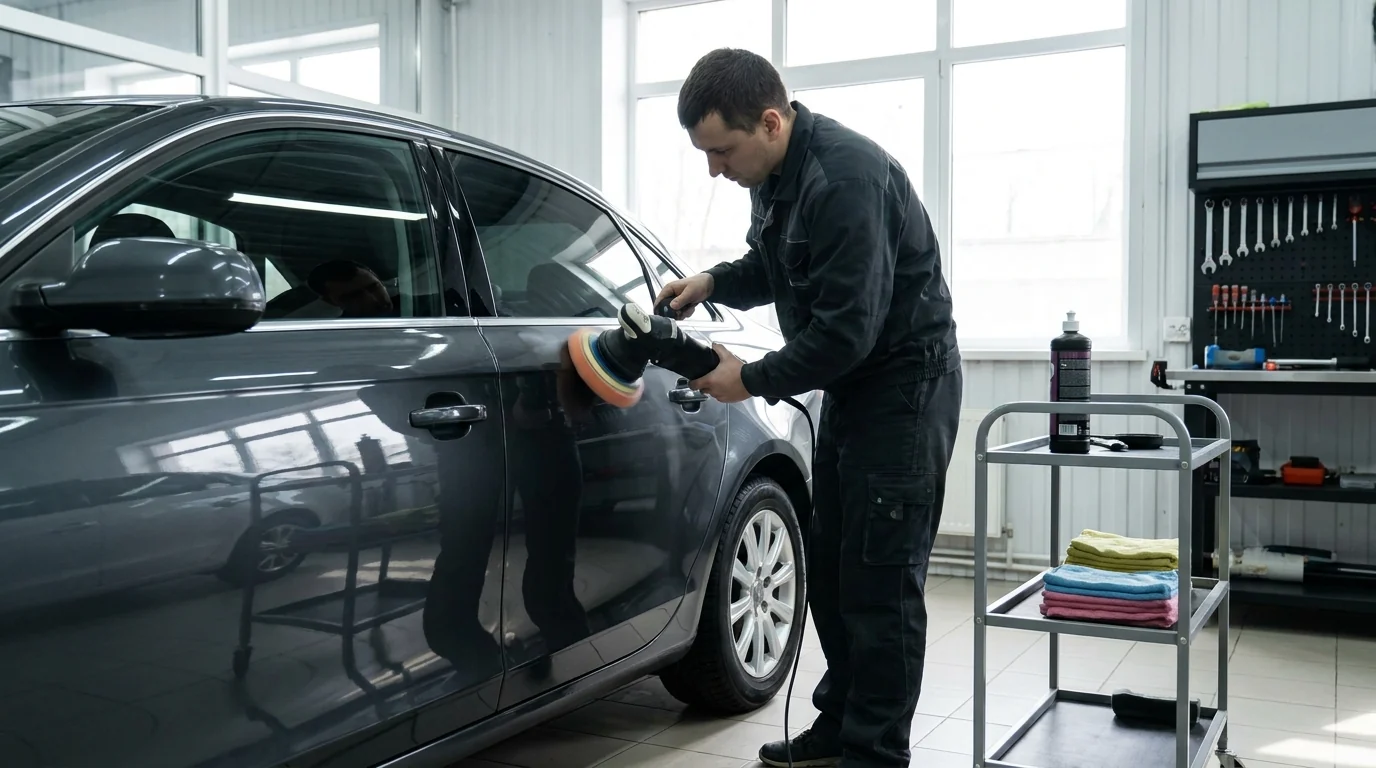
Car polishing is a procedure involving the mechanical treatment of the paintwork's clear coat to remove fine scratches, swirl marks, and cloudiness, restoring the body's deep color and factory shine. Simply put, it's a way to refresh your car's appearance without resorting to repainting. It's important to understand that polishing only works on the top layer of the clear coat. It's not a panacea for deep damage that has reached the primer or metal, but it can make such blemishes less noticeable. There are two main types: restorative (abrasive) polishing, which physically removes defects, and protective polishing, which adds a layer to the surface for shine and to preserve the result. At our service center in Kyiv, this service starts at 5 500 ₴ and usually takes one day.
When is polishing necessary, and when is it a waste of money?
Polishing the car body makes sense when the clear coat has lost its original shine, become dull, and a dense web of fine circular scratches—so-called 'swirl marks'—is visible under sunlight or artificial light. These are common consequences of automatic brush car washes, improper wiping of the body, or simply the effects of time. Polishing is also effective against shallow scratches from branches, fingernails under door handles, or light scuffs. It's an excellent way to prepare a car for sale, significantly improving its marketable appearance.
However, there are cases where polishing is a waste of money. The main indicator is the depth of the scratch. If you run your fingernail over it and it clearly catches, or if you can see a white layer of primer or dark metal beneath the clear coat, polishing is powerless. It can only slightly smooth the edges of the scratch but won't remove it. Trying to 'buff out' such a defect completely means destroying the surrounding clear coat. You also shouldn't polish panels where the clear coat has started to peel or flake. In such situations, only a spot repair will help.
Another clear test to see if polishing makes sense is to run your palm over the clean, dry body under bright sun or a spotlight. If the surface feels smooth to the touch and the swirl marks are only visible at a sharp angle to the light, it's a cosmetic defect in the top layer of the clear coat, and polishing will remove it almost completely. If, however, you can feel indentations or roughness with your finger, it's mechanical damage deeper than the clear coat, and the procedure itself will be ineffective.
One more practical indicator is the car's age and the number of times it has been resold. A car that has been through several owners and an unknown number of car washes with harsh brushes almost always has accumulated swirl marks, even if it looks well-maintained on the surface. A first inspection of the paint under a spotlight is the cheapest way to understand what to invest in: polishing or looking for another car altogether.
Polishing does not remove deep scratches that have reached the primer or metal. It can only smooth their edges and make them less noticeable. Complete restoration of such defects is only possible through repainting.
Types of Polishing: Restorative, Protective, and Pre-Sale
Depending on the condition of the paintwork and the goal, we select the appropriate type of polishing. The most common is restorative, or abrasive, polishing. Its essence is to use special pastes with abrasive particles to remove a microscopic layer of the clear coat, leveling the surface and eliminating scratches. This is precision work that requires experience, as the main thing is not to overdo it and 'burn through' the clear coat.
Protective polishing is essentially the application of wax, sealants, or other compounds that create a thin protective film on the surface. It adds extra shine, a hydrophobic effect (repelling water and dirt), and protects the paintwork from UV rays and aggressive chemicals. This type does not remove scratches but preserves the existing condition. It's often done after restorative polishing to seal in the result. Pre-sale body polishing is usually a light, one-step abrasive process aimed at quickly and inexpensively giving the car maximum shine before showing it to a buyer.
The softness of factory clear coats also varies between brands: some German and Japanese cars have harder clear coats that are more forgiving of mistakes, while on some models with softer clear coats (typically dark colors and certain American brands), the abrasive paste removes the layer faster, and the technician must work more carefully, with less pressure and at lower speeds. This is another reason why there is no universal 'time for polishing' for all cars.
The best polish is the one that's followed by a protective coating. Without it, you're just buying a temporary shine that will wash away with the first few car washes.
Before agreeing to a polish, ask the technician to measure the thickness of your paintwork. A professional will always do this to ensure that removing a thin layer of clear coat is safe for your car.
How does the process work, and does polishing 'thin' the clear coat?
Proper polishing is a multi-stage process. It all starts with thorough preparation: the car undergoes a two-phase comprehensive wash, and is cleaned of tar, metal particles, and other deep-seated contaminants. Polishing on a dirty surface just creates new scratches. Next, we inspect the paintwork and measure its thickness with a special device. This allows us to understand how much clear coat can be safely removed. All plastic and rubber parts, as well as glass, are masked with painter's tape to avoid damaging them with the paste.
The polishing process itself usually involves several steps: first with a coarse abrasive paste to remove the main scratches, then a medium one, and finally, a finishing anti-hologram paste to achieve maximum shine. After this, the body is degreased. And yes, abrasive polishing does make the clear coat layer thinner. But a professional removes the minimum possible layer, which is completely safe for the overall thickness of the factory paint, provided the procedure is not overused. This is why we always honestly tell you if there is still a 'margin' for polishing on your car.
What to do after polishing to maintain the shine for a long time?
A polished car body looks great, but the clear coat is left 'naked' and vulnerable after the procedure. Without protection, the effect of polishing will last a few months at best, and the very first automatic car wash can bring back some of the swirl marks. Therefore, the smartest solution is to protect the result immediately. The best option is to apply a long-lasting protective coating.
There's also a practical connection to pre-purchase inspections: the paint thickness gauge a technician uses before polishing is the same tool that reveals hidden repaint jobs on a used car. If you're buying a car from a private seller, measuring the paint thickness is both a part of the pre-sale inspection and a reason to plan for polishing right away if you need to freshen up its look.
There are several ways to do this. You can apply a ceramic or quartz coating, which creates a hard, glass-like layer over the clear coat that protects against minor scratches and chemicals. Or you can go a step further and wrap the body in paint protection film. We've covered this in more detail in a separate article: Protective Film for Cars: Why and When You Need It. It's also important to properly care for the car afterward: use high-quality hand wash services and avoid wiping the body with a dry cloth. By the way, while a car is with us for detailing, many clients combine polishing with interior deep cleaning to get the feeling of a completely renewed vehicle. You can read about what's included in a deep interior cleaning and when it's really needed in our separate guide on car interior deep cleaning.
How much does polishing cost and what does the price depend on?
Body polishing at our service center starts from 5 500 ₴, and the entire process—including preparation, masking, and finishing with an anti-hologram paste—takes about one day. This price isn't for a 'quick wipe-down' but for a multi-stage job: washing, measuring paint thickness, several passes with abrasives of different grits, and degreasing.
The final cost depends on three things. First is the size and class of the car: an SUV has a larger body surface area than a hatchback, and this directly affects labor hours. Second is the condition of the paint: a car with swirl marks all over its body after years of daily automatic car washes requires more passes than a recently purchased car with just a couple of minor scratches. Third is the scope: local polishing of a hood or bumper costs significantly less than the entire body.
We always provide the exact price after an in-person inspection of the car, not over the phone—too much depends on the actual condition of the paint. We service BMW, Mercedes, Audi, Lexus, Land Rover, Volvo, MINI, Porsche, Volkswagen, Toyota, Mazda, Kia, and Hyundai, and each brand has its own nuances regarding factory paint thickness and coating softness.
The Bottom Line
Polishing effectively removes minor scratches, cloudiness, and swirl marks, restoring a car's shine. It is powerless against deep damage that reaches the metal. To preserve the result for a long time, a polished body should immediately be treated with a protective coating or film. A transparent estimate and before-and-after photos are standard practice for any type of polishing at our service center.
Frequently asked questions
Book in a minute —
Leave your number and we'll call back. Or share the details so the technician can prepare.
Book nowWhat clients say.
Honest Google reviews. Unedited.