3D wheel alignment
3D wheel alignment in Kyiv at Tyraspilska St, 12 — ₴1,000–1,200 depending on the car. On a computerized Beissbarth 3D stand we set the wheel angles — toe, camber and caster — precisely to your car's factory tolerances. Correct suspension geometry means even tyre wear, stable handling on the highway, precise steering with no shimmy, and predictable behaviour in corners. We do a wheel alignment after suspension repair or tyre service — that's when the angles get knocked off most often — and also on a routine maintenance schedule.

What 3D wheel alignment is and which angles we adjust
Wheel alignment is adjusting the suspension geometry — more precisely, three angles of each wheel's position relative to the body and the road: toe, camber and caster. Together they determine how the wheel contacts the asphalt, how evenly the tread wears, and how the car responds to steering input.
Toe is the angle between the direction the wheels point and the car's longitudinal axis, viewed from above. Incorrect toe is the most common cause of uneven tyre wear and the feeling that the steering "won't hold" a straight line.
Camber is the wheel's inward or outward tilt, viewed from the front. Knocked-off camber makes the tread wear more on one edge of the tyre.
Caster is the angle of the wheel's steering axis tilt, viewed from the side. It affects steering stability at speed and how easily the wheels return to straight after a turn.
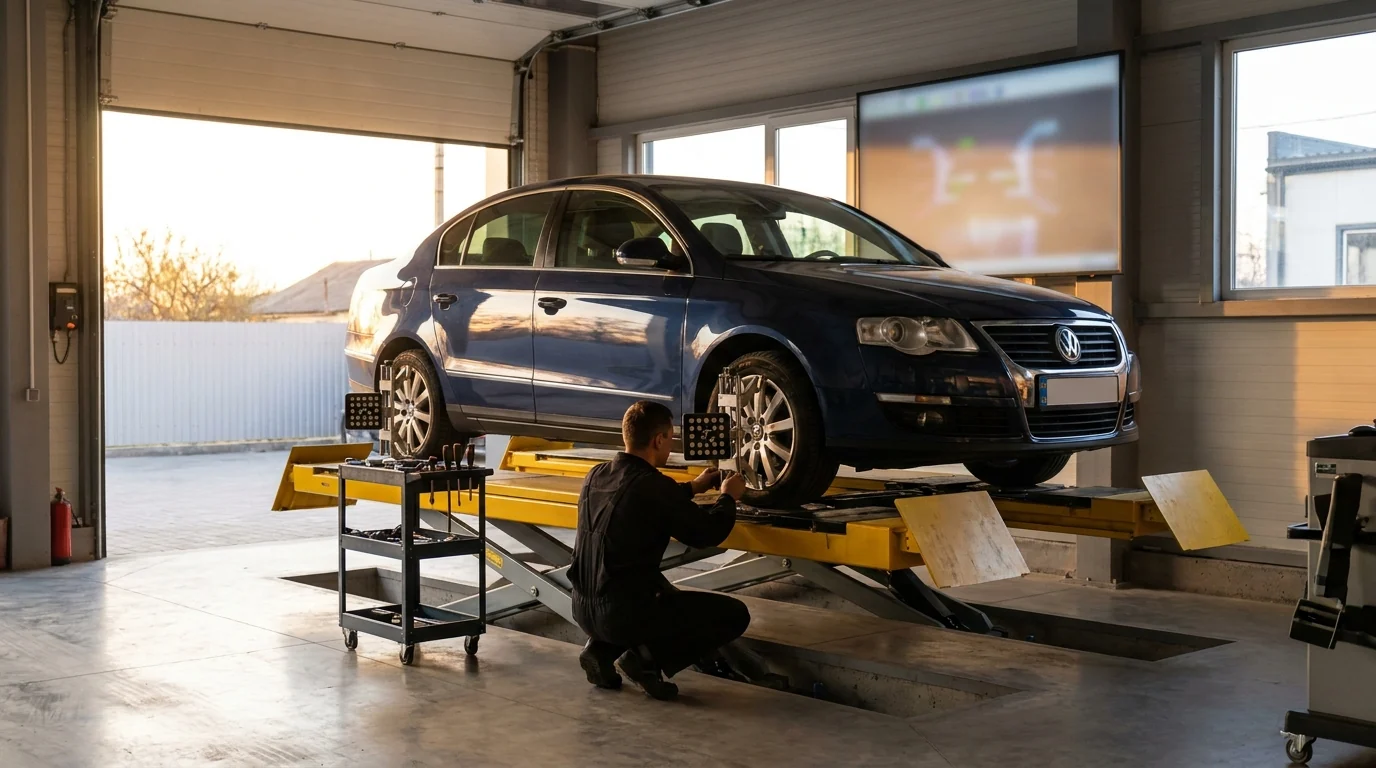
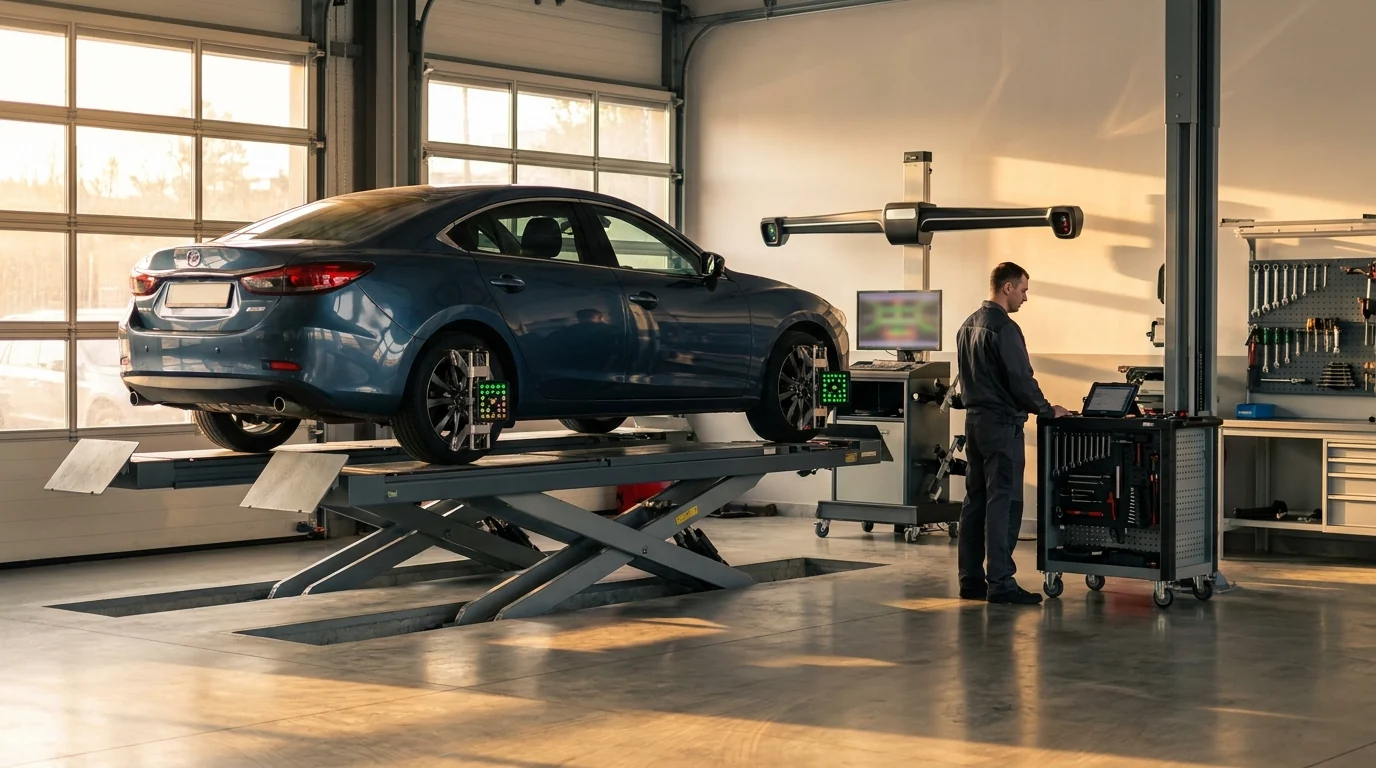
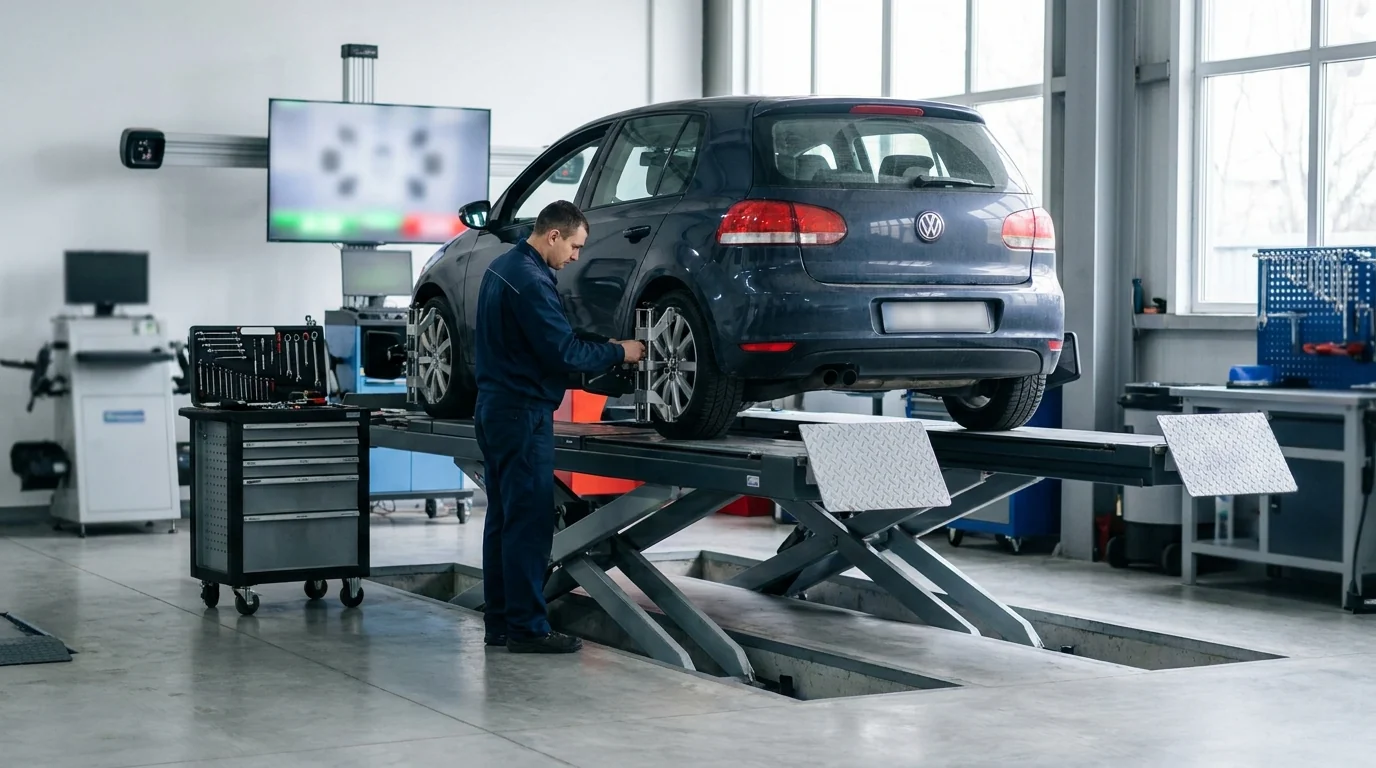
"3D" in the stand's name refers to the measurement method: a target with a special pattern is mounted on each wheel, the Beissbarth stand's cameras read its position in space and build a precise 3D model of the suspension geometry. The wheel clamps are contact-free — they grip the tyre's edge instead of squeezing the rim with a clamp, so alloy wheels stay free of scratches.
Symptoms: when you need a wheel alignment
A few signs suggest the suspension geometry is off and it's time for the 3D stand.
The car pulls to one side on a flat road — you have to keep correcting the steering to drive straight, even though the road is level with no camber.
The steering wheel sits crooked (turned to one side) when the wheels are actually pointing straight.
The tyre wears unevenly: more on one edge of the tread than the other, or in patches — noticeable at a routine tyre service or during an inspection.
Vibration appears in the steering wheel at a certain speed, even though the wheels are balanced — worth checking the geometry together with the balancing.
A wheel alignment is also worth checking after replacing suspension parts, after suspension repair, after a hard hit on a pothole or a curb, and after fitting new tyres — these are exactly the moments when the angles get knocked off most often.
How the procedure goes on the Beissbarth 3D stand
The car drives onto the stand's lift, the technician checks the tyres' condition and pressure — even pressure is needed for an accurate measurement.
Targets are mounted on each wheel, the Beissbarth stand's 3D cameras read their position in space and build a model of the current suspension geometry for all wheels at once.
The system compares the measured toe, camber and caster angles against the factory tolerances for your exact car model — the stand holds a database of manufacturer specifications.
If there's play or wear in the suspension, the technician flags it before adjusting: angles won't hold on worn parts. Trickier cases that need extra equipment to change the angles go to geometry adjustment.
The technician then adjusts the tie rods, eccentric bolts and strut bolts until every angle falls within the factory tolerance, takes a final measurement, and can issue a before/after printout with the numbers.
Why we check the suspension first
On a worn suspension — with play in the ball joints, bushings or tie-rod ends — the set angles won't hold for long: the car will pull to one side again within days or even hours. So when we find play, we first offer suspension repair and only then set the geometry on a sound suspension — this saves your money, since adjusting angles "into nothing" makes no sense.
Checking the suspension's condition before a wheel alignment is free — you see the suspension's real state before paying for the angle adjustment.
How much 3D wheel alignment costs
The price is ₴1,000–1,200 depending on the car.
A free suspension condition check is included with any option. Prices are for passenger cars; SUVs and non-standard suspensions are quoted individually after inspection.
The price difference within that range reflects the amount of work on the stand: the front axle can be set on its own (say, after replacing tie-rod ends), while a full four-wheel adjustment is a longer measurement-and-adjustment cycle on every wheel.
How long the procedure takes
The procedure itself on the Beissbarth 3D stand takes roughly 40–60 minutes for a passenger car. Including driving onto the lift, mounting the targets and the final check, the total visit is roughly 1–1.5 hours.
If the adjustment is complicated by seized bolts, rusted fasteners, or suspension repair is needed first, the technician warns you in advance and gives an estimate of the extra time.
What happens if you put off a wheel alignment
Knocked-off suspension geometry speeds up uneven tyre wear — the tread "eats away" on one side much faster, so tyres need replacing more often than under normal use.
Wrong wheel angles increase rolling resistance, so the engine burns more fuel to maintain the same speed.
Handling becomes less predictable: the car holds a straight line worse, returns to straight more slowly after a turn, and on a wet or slippery road this noticeably affects braking distance and safety.
The longer a car runs with knocked-off angles, the more the tyres themselves wear — and replacing them costs substantially more than a timely wheel alignment.
How to prepare for a wheel alignment appointment
Before the visit it's worth checking tyre pressure against the manufacturer's spec — otherwise the stand's measurement will be inaccurate and the adjustment will need repeating later.
If the car has a visible suspension fault — a knock, play, body roll in corners — tell the technician right at booking: you may need suspension repair first, with the wheel alignment scheduled logically after it.
Arrive with roughly the car's normal load (no sudden overload in the trunk) — cabin weight also slightly affects the wheel angles.
The essentials, briefly.
Guides on this topic
What clients say.
Honest Google reviews. Unedited.




Book in a minute —
Leave your number and we'll call back. Or share the details so the technician can prepare.
Book now