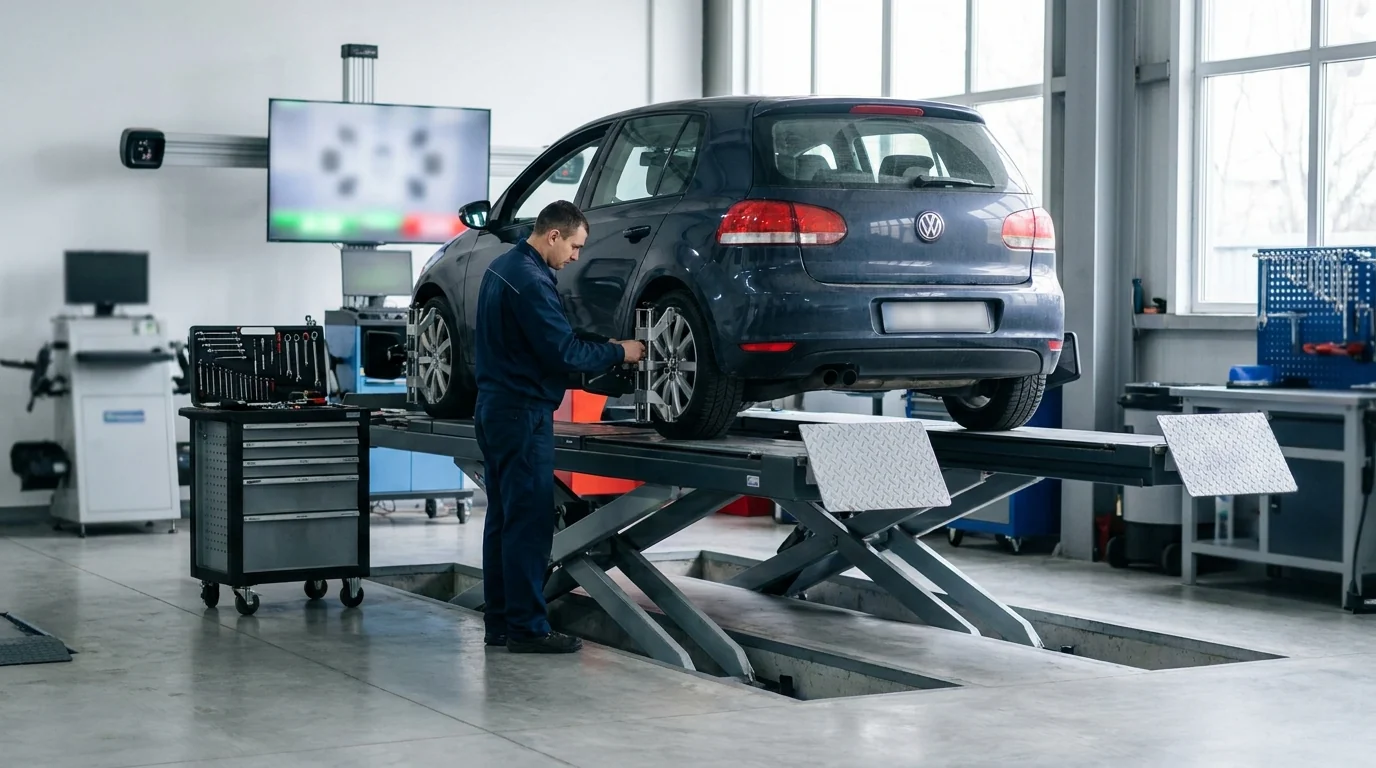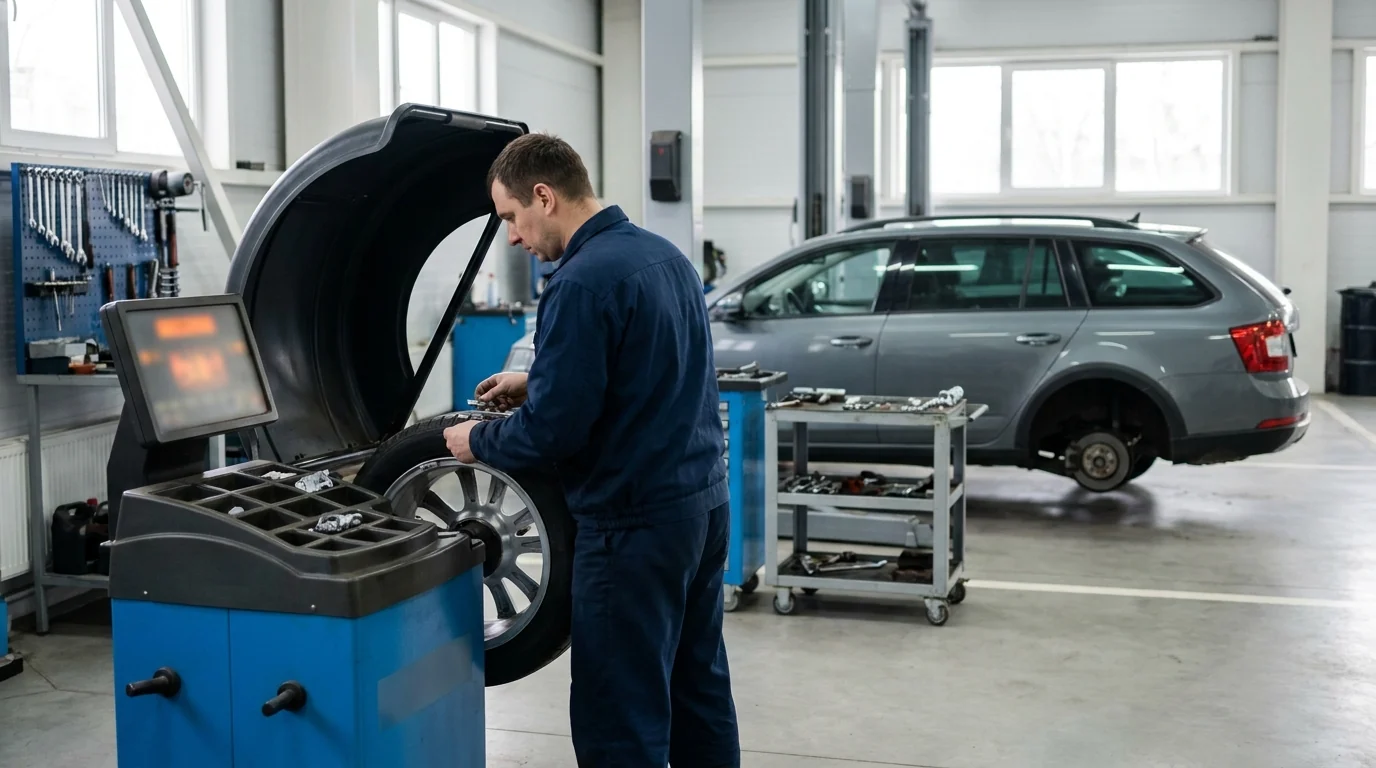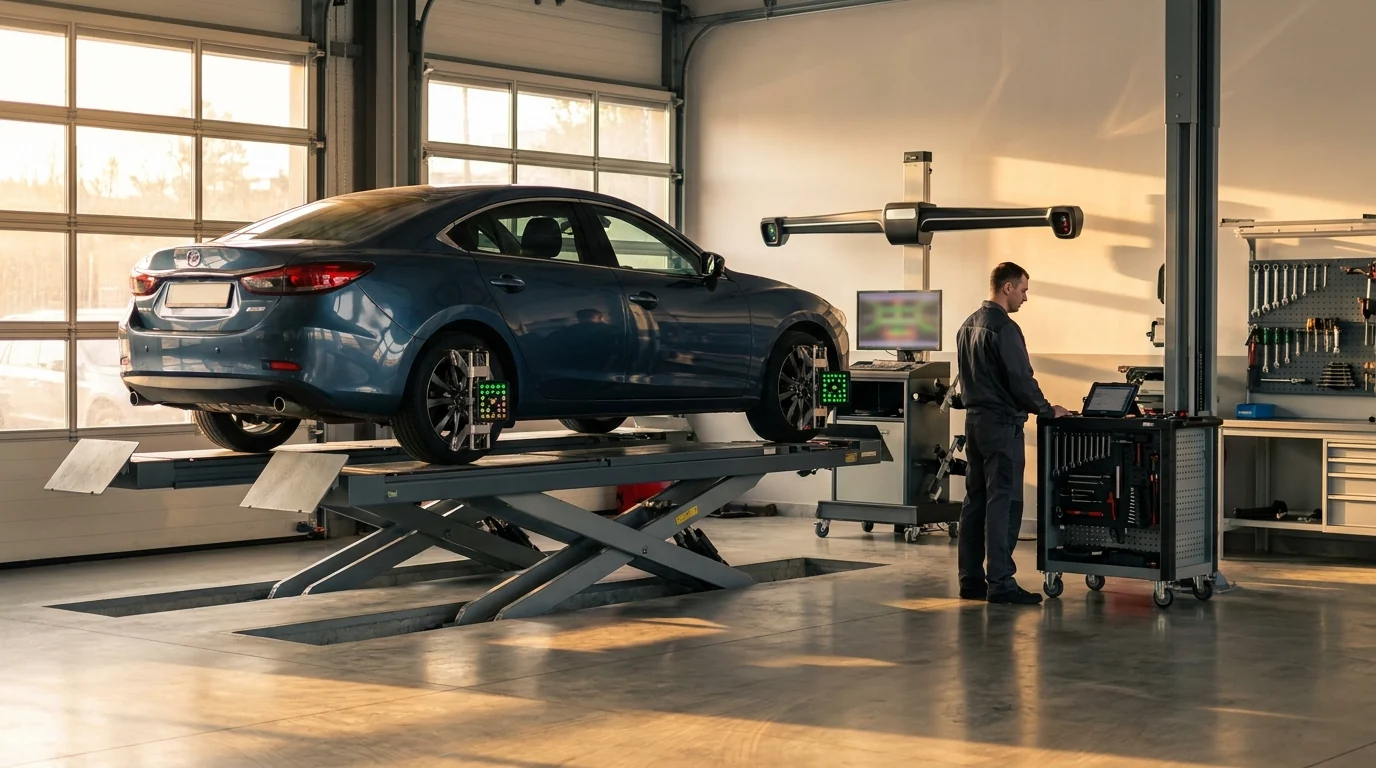
A mechanic's honest answer: there's no rigid 'do it every X miles' interval. The guideline is once a year or every 10,000–15,000 km, but that's a suggestion, not a diagnosis. You get an alignment not by the calendar, but when the wheel angles are off—and they get thrown off by specific events: suspension repairs, new tires or a tire fitting, hitting a pothole or curb, or a seasonal tire swap. And also, as soon as the car starts telling you: it pulls to one side, the steering wheel is crooked when driving straight, or the tires are wearing unevenly on one edge. At єМеханік, located at 12 Tyraspilska St., we perform 3D wheel alignments on a German Beissbarth stand—with contact-free clamps that protect your rims—and set the angles to your specific vehicle's factory tolerances. The short version: it's cheaper to check your geometry than to buy a new set of tires you've destroyed in one season with bad angles.
The Interval is a Guideline, Not a Rule
The general recommendation is to check your wheel alignment about once a year or every 10,000–15,000 km. This is a convenient benchmark, but just a benchmark: the actual need depends on road conditions, your driving style, and what's happened with the suspension. On our German Beissbarth 3D stand, we check and set the angles in 1–1.5 hours.
If you drive a lot on Kyiv's broken roads, the interval shortens. If the car is newer, the roads are mostly smooth, and your driving is calm, the angles hold longer. That's why the calendar is a suggestion, not a diagnosis: focus primarily on suspension events and your car's behavior, not a number in your head.
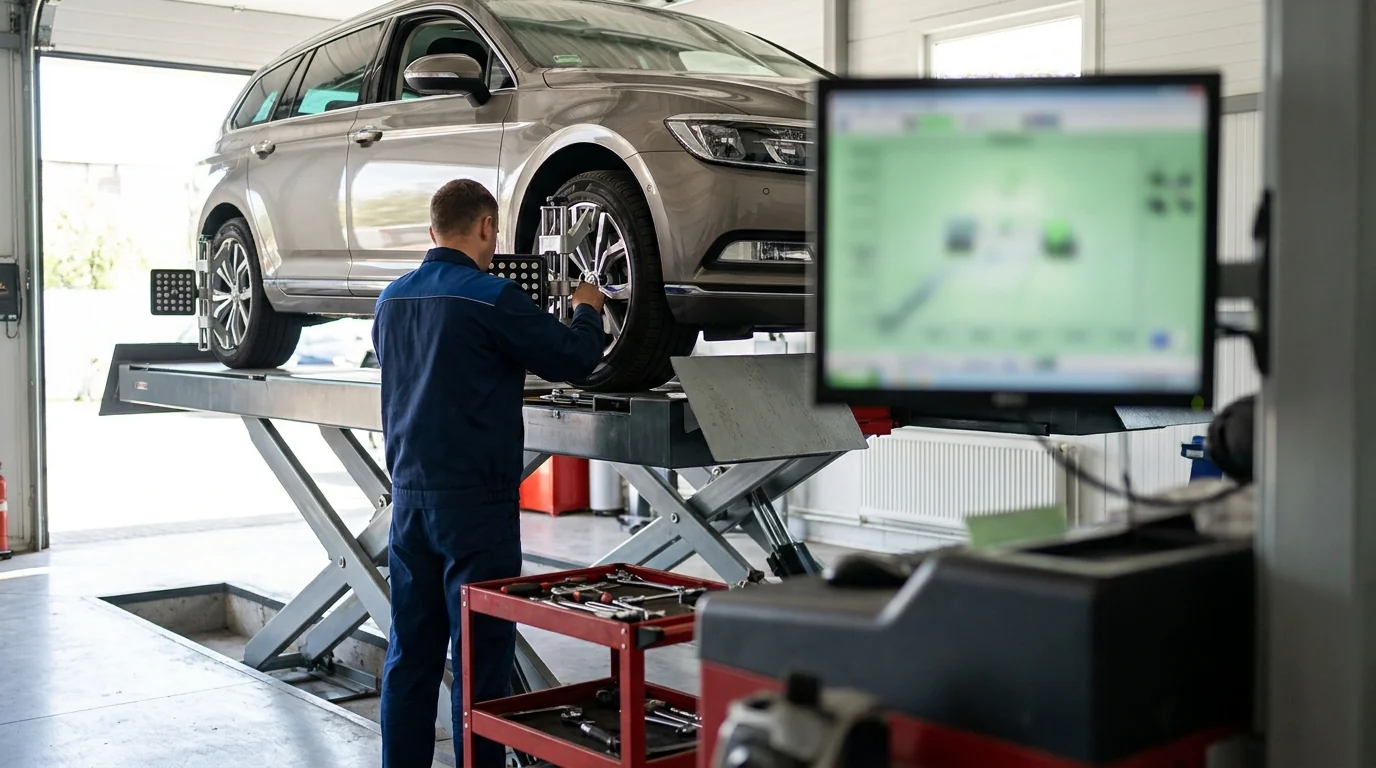
After any suspension work or tire change, check the angles—even if the car 'drives straight.' Misaligned geometry isn't always felt through the steering wheel, but it always eats tires.
When Alignment is Needed Regardless of Mileage
There are events that are guaranteed to throw your angles off—and mileage has nothing to do with it. First is any suspension repair: replacing control arms, bushings, struts, or tie rods changes the geometry, and the angles must be reset. Second is tire fitting and replacement: new tires on misaligned wheels will wear unevenly within just a few thousand kilometers.
Third is hitting a pothole or curb: even with no visible damage, the toe angle shifts, as it's the most sensitive of the angles. This also includes seasonal tire swaps, lowering or lifting the suspension, and replacing springs. After any of these, don't wait for a 'scheduled' check: first, a suspension diagnostics, then the alignment stand.
You get an alignment not by the calendar, but after an event: suspension repair, new tires, or hitting a pothole.
Don't bring a car with faulty suspension to the alignment rack. Play in worn-out parts will cause the angles to 'float' as soon as you drive off, making the adjustment useless. Diagnostics first, then alignment.
What Are the Angles and Why Are There Three?
To understand what's being adjusted on the stand, it's helpful to know the three parameters. Toe is whether the wheels on an axle point inward or outward; it's the most sensitive angle and the one that 'eats' tires the most. Camber is the inward or outward tilt of the wheel from the vertical; excessive camber wears the inner edge of the tire. Caster is the tilt of the steering axis; it's responsible for how the steering wheel returns to center and how confidently the car holds a straight line.
On our 3D stand, we first show you your current angles, compare them with the factory tolerances for your car, and only then set the angles on the stand—you see the before and after numbers, not just take our word for it. If you're unsure whether it's time, pay attention to the symptoms—we cover those separately in our article on the signs that your alignment is off.
The Classic Mistake That Costs a Set of Tires
Here's the most common story from the service bay: a person installs a new set of tires, and a season later is surprised to find the front tires are 'bald' on the inside edge. The reason is simple—they didn't check the angles after the installation, and the alignment had been off since winter. The new tires wore through a quarter of their lifespan in just a few months.
The practical takeaway: a wheel alignment isn't for when things are 'already really bad,' but a preventative measure after every significant event involving the suspension or tires. A check on the stand costs many times less than a prematurely ruined set of tires.
Frequently asked questions
Book in a minute —
Leave your number and we'll call back. Or share the details so the technician can prepare.
Book nowWhat clients say.
Honest Google reviews. Unedited.