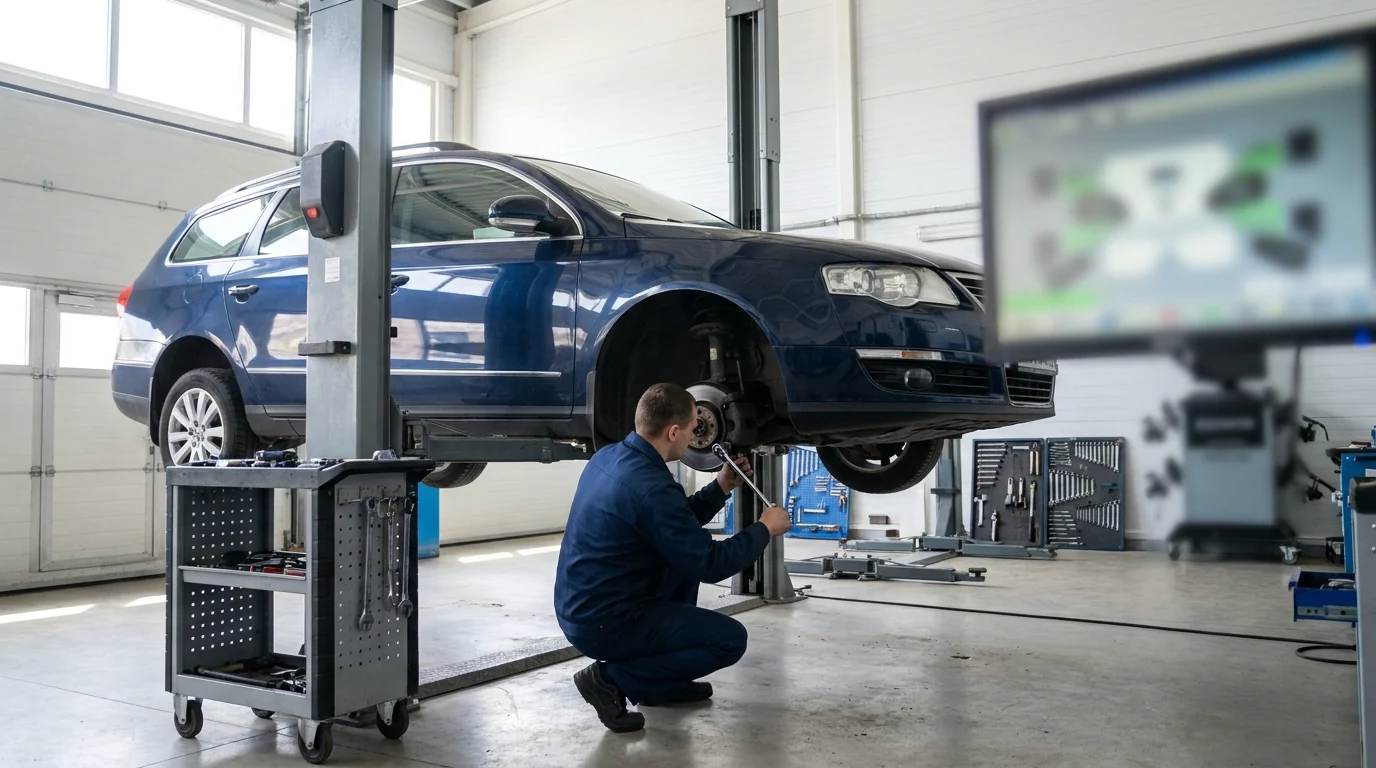
The main symptoms of a faulty electronic control unit (ECU) are a persistent "Check Engine" light that doesn't go away after being reset, engine starting problems, a noticeable loss of power, unstable idling, and incorrect automatic transmission behavior. The problem can also be indicated by failures of individual systems controlled by the ECU, such as the fuel pump or cooling fans, even though the components themselves are working. The ECU is your car's central computer, managing dozens of processes, from fuel injection to transmission operation. When it starts to fail, the car's behavior becomes unpredictable, and standard diagnostics often can't find the cause. Unlike simply reading codes, targeted ECU diagnostics allows a technician to delve into its operational logic, check sensor signals in real time, and identify hidden software or hardware defects. This is a job for an experienced diagnostician that requires specialized equipment and a deep understanding of the processes involved.
Key Symptoms of ECU Failure: When to Sound the Alarm
The very first and most obvious signal is the "Check Engine" light on your dashboard. But not every "check" points to the ECU. A worrying sign is when the error reappears almost immediately after being cleared, or when the scanner produces a whole set of chaotic, unrelated codes. This may indicate that the control unit has lost its ability to correctly interpret data from sensors or has internal damage. Sometimes the warning light isn't on, but the engine problems are obvious.
Engine performance issues are the second most common symptom. This can manifest as a loss of traction, jerking during acceleration, fluctuating idle RPMs, or a complete refusal of the engine to start. Since the ECU controls fuel delivery and ignition timing, any malfunction in its operation instantly affects these processes. For example, the unit might unnecessarily put the engine into limp mode, limiting power, or supply an incorrect fuel mixture, leading to increased fuel consumption and black smoke from the exhaust pipe. If you notice such signs, it's worth starting with a thorough engine diagnostics to rule out mechanical causes.
Incorrect operation of the transmission and other accessories can also be a consequence of ECU problems. Modern automatic transmissions are closely integrated with the engine control unit. A communication failure between them leads to harsh shifting, delays, or getting stuck in one gear. In addition, the ECU controls the operation of the fuel pump, cooling system fans, EGR valve, and other actuators. If, for example, the fan doesn't turn on when the engine overheats, even though the fan itself is functional, the cause may lie in the control signal from the unit. Such problems are often confused with electrical faults, so it's important to distinguish when you need diagnostics for the electrical system, starter, or battery, and when you need to check the control unit itself.

A sensor error doesn't always mean the sensor is faulty. Often, the ECU registers a problem because it's not receiving a signal from it due to damaged wiring. Therefore, diagnostics always starts with checking the circuit, not with a hasty replacement of parts.
How Is ECU Diagnostics Different from Standard Computer Diagnostics?
Many drivers believe that connecting a scanner and reading error codes constitutes a full diagnosis. In reality, this is only the first step, comparable to taking a patient's temperature. Computer diagnostics is a quick, general overview of the state of all the car's electronic systems. The scanner queries each module (engine, transmission, ABS, airbags) and displays the fault codes (DTCs) stored in their memory. This gives a general idea of where to look for the problem, but it doesn't answer the question of 'why did it happen?'.
Targeted ECU diagnostics is a much deeper process, similar to a consultation with a specialist. Here, the technician doesn't work with all systems at once but focuses on one specific unit. Using dealer-level or professional multi-brand equipment, they can not only read errors but also view live data from sensors, check the unit's software version, run tests on actuators (e.g., forcibly turn on a fan or an injector), and analyze the program's logic.
Imagine that a standard diagnosis showed a 'misfire in cylinder 3' error. What's next? Replace the spark plug, coil, injector? ECU diagnostics allows us to check if a control pulse is being sent to the coil, what signal the unit is seeing from the knock sensor, and whether it is correctly calculating the injection time for that injector. This allows us to determine precisely whether the problem is in the coil itself, the wiring to it, or perhaps the control unit itself has failed. This approach helps avoid the unnecessary replacement of working parts.
The most expensive ECU repair is replacing a perfectly good ECU when the problem was a bad contact or a broken wire right next to it.
Not all problems are solved by flashing. Sometimes, 'chip tuning' from unverified technicians is the cause of ECU failure. We don't engage in questionable power boosts; we restore standard, reliable electronics operation.
When Do You Need Targeted ECU Work, Not Just Code Reading?
The most common situation where working with the ECU is unavoidable is adaptation after replacing important components. When you install a new throttle body, injectors, EGR valve, or sometimes even a battery, the car may not always start working with them correctly right away. The control unit needs to 'learn' about the new part and adjust its operation to its parameters. This process is called adaptation or basic settings. Without it, the new part may work worse than the old one, or not at all.
The second case is problems with the immobilizer and starting. If the car does not respond to the key and the starter cranks but the engine won't start, the problem often lies in a loss of communication between the engine control unit and the immobilizer module. They 'don't recognize' each other, and the ECU blocks the engine from starting. In such a situation, simply reading the error codes will do nothing. It is necessary to check the immobilizer status, key synchronization, and the communication between the units, and if necessary, 'pair' them again.
In-depth diagnostics are also needed for 'intermittent' faults that appear and disappear for no apparent reason. For example, a car might run perfectly in the morning, then start to misfire and lose power at noon, and then everything goes back to normal. Such symptoms rarely leave clear error codes. Here, the diagnostician must analyze the engine's operating parameters in different modes, looking for anomalies in the data that could indicate the initial stage of a sensor failure, contact problems, or a software glitch in the ECU itself.
What the Technician Does: Adaptation, Coding, and Flashing ECUs
Adaptation is the procedure of 'introducing' the control unit to a new or cleaned component. For example, after cleaning a throttle body, its end positions may shift slightly. Adaptation allows the ECU to relearn these positions to correctly regulate the idle speed. The same applies to adapting the automatic transmission after an oil change (resetting the oil aging counter and pressure corrections), registering a new battery (so the charging system works correctly), or programming the codes for new injectors.
Coding is changing the vehicle's configuration. From the factory, the ECU is programmed with various setting options for different markets and trim levels. Through coding, you can activate or deactivate certain functions. For example, if you retrofit your car with cruise control or a rain sensor, you need to 'inform' the relevant control units about this by changing their coding. This is a job that requires precision, as incorrect coding can lead to errors or the failure of some systems.
Flashing (or programming) is the process of updating the software of the control unit itself. Manufacturers periodically release software updates that fix known bugs, improve fuel efficiency, or resolve issues with the operation of certain systems. Flashing is also necessary when replacing an ECU with a used one from another car. In this case, the immobilizer data and VIN code must be transferred from the old unit to the new one for the car to 'accept' it. This is a complex procedure that requires special equipment.
ECU or Wiring: How to Find the Real Cause of the Problem
One of the biggest mistakes in diagnostics is to hastily blame the control unit. Very often, when a scanner shows an error for a sensor or even the ECU itself, the problem lies not in the unit, but in the circuit between it and the actuator. This could be a broken wire, a corroded contact in a connector, a bad ground, or a short circuit. The control unit simply records that it is not receiving the expected signal and reports it as an error code.
The correct diagnostic approach always includes checking the entire circuit. First, we check the sensor or actuator itself. Then, using a multimeter and an oscilloscope, we check the wiring: is there power, is there a reliable ground connection, is the signal wire damaged? Only after we are sure that the sensor and wiring are in perfect condition and the signal reaches the ECU connector do we begin to suspect the unit itself.
This approach saves the client time and money. Replacing an ECU is an expensive procedure, and there is nothing worse than installing a new unit only to see the same error because the cause was a frayed wire, the repair of which costs incomparably less. That is why, if there are suspicions of a complex electrical problem, we involve specialists in automotive electrical diagnostics. Their job is to thoroughly check all circuits before passing judgment on the control unit.
Is Flashing and Coding an ECU Safe? Risks and How We Avoid Them
Any interference with the software of a car's 'brain' carries certain risks. The biggest danger is an interruption of the programming process. If the power supply is lost or a communication error occurs while writing the new software, the unit can get 'bricked' and stop responding. In such a case, its recovery can be very difficult and expensive, and sometimes impossible. That is why such procedures should not be done 'on the fly' without proper preparation.
To minimize all risks, we adhere to a strict protocol. First, before making any changes, we always make a backup copy of the original firmware and coding. This is our insurance, allowing us to revert everything to its initial state if something goes wrong. Second, during programming, a voltage stabilizer is always connected to the car. It ensures that the battery will not discharge at the most critical moment and that the voltage in the onboard network will be stable.
We use only verified, licensed equipment and official software versions that correspond to the specific make and model of the car, whether it's ECU diagnostics for a Volkswagen or an Audi. We deliberately do not engage in questionable 'chip tuning' to squeeze maximum power out of the engine at the expense of its lifespan. Our goal is to restore the correct, standard operation of the electronics, eliminate software glitches, and adapt components for the reliable operation of the vehicle. This is an honest approach that guarantees safety for your car.
The Bottom Line
Unstable engine operation, persistent errors, and strange automatic transmission behavior are direct indications for in-depth ECU diagnostics. Unlike a general error code reading, a targeted check of the car's 'brain' allows us to find the root of the problem, perform necessary adaptations after repairs, and avoid replacing perfectly good parts. If you notice similar symptoms in your car, don't delay—schedule a diagnostic appointment.
Frequently asked questions
Book in a minute —
Leave your number and we'll call back. Or share the details so the technician can prepare.
Book nowWhat clients say.
Honest Google reviews. Unedited.