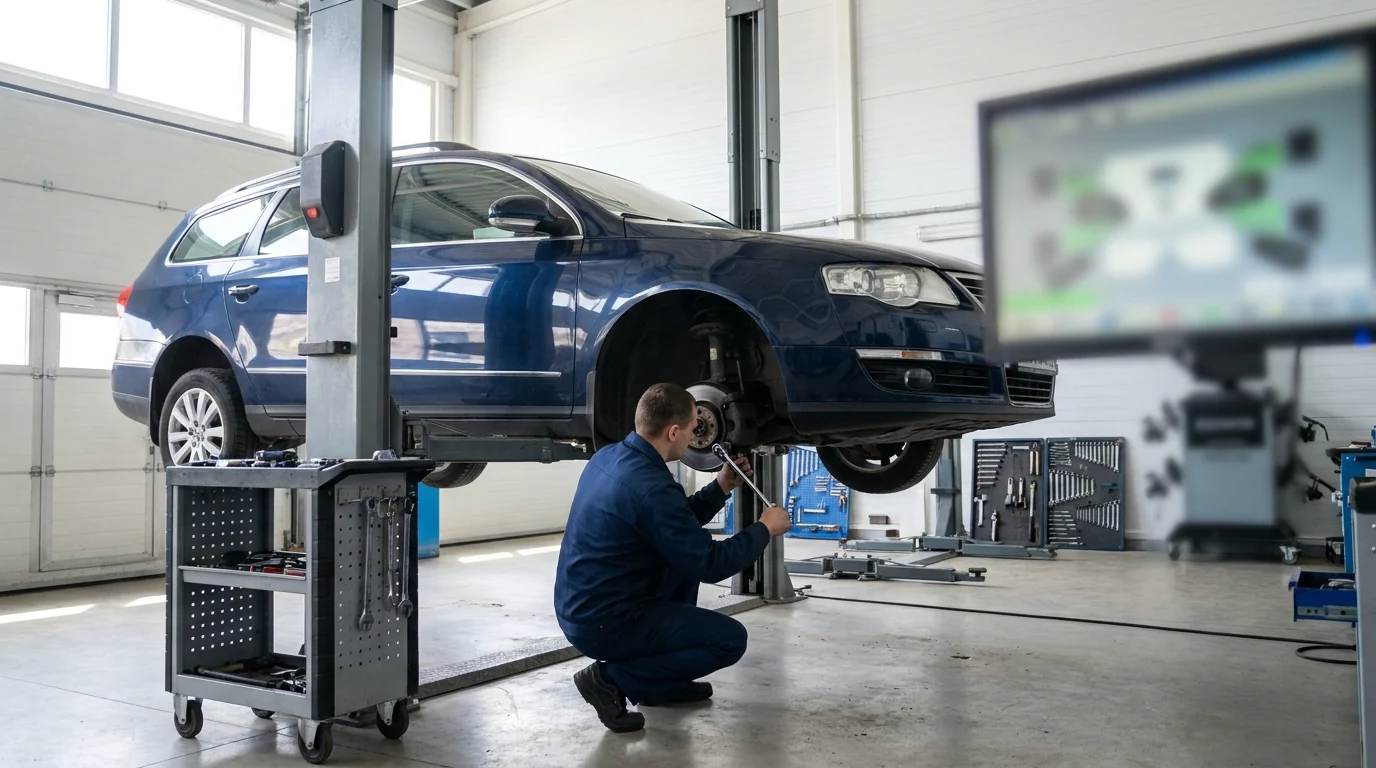
Urgent diagnostics of the electronic control unit (ECU) is needed when the 'Check Engine' light is on and won't clear, the car won't start for no apparent reason, it stalls while driving, or when new parts—injectors, throttle body, automatic transmission—work incorrectly after replacement. These are direct signs that the problem lies not in the mechanics, but in the car's 'brain,' and a simple error code reading won't help. This requires in-depth, targeted work on a specific unit to find the root of the fault, not just temporarily mask its symptoms. Unlike general computer diagnostics, which only registers the fact of an error, ECU diagnostics allows for real-time analysis of sensor data, checking the unit's software, and performing adaptations and coding. This is the only way to solve complex electronic problems, restore communication between modules, and make the car work as a single, cohesive mechanism.
Urgent Signs: When You Need In-Depth ECU Diagnostics
The very first and most obvious sign is the 'Check Engine' indicator on the dashboard that doesn't disappear after clearing errors with a standard scanner. If the error returns immediately or after a short time, it means the system is detecting a persistent fault, and its cause may be the incorrect operation of the control unit itself. The unit might be receiving incorrect data from sensors, misinterpreting it, or failing to send commands to actuators. Ignoring such a signal can lead to increased fuel consumption, loss of power, and ultimately, more expensive repairs of engine components.
A second group of serious symptoms is related to the behavior of the engine and transmission. If the car suddenly stalls at idle or while driving, has trouble starting when hot or cold, or you feel hesitation when pressing the gas pedal—this could indicate a failure in the engine ECU. Similarly, incorrect operation of the automatic transmission—jerks, delays in shifting, switching to limp mode—is often a consequence of problems with the transmission control unit or a loss of communication between it and the engine unit. In such cases, you need in-depth ECU diagnostics, not just an oil change in the gearbox.
A third warning sign is the failure or incorrect operation of individual electronic systems. For example, the car stops responding to the key, even though the battery in it is new. This could be a failure of the immobilizer system, which is 'written' into the ECU. Another example: after replacing injectors, the throttle body, or even the battery in a modern car, the vehicle behaves strangely. This happens because the ECU doesn't 'know' about the new part and operates on old parameters. Without an adaptation procedure, the new component will never work correctly. This is especially true for complex systems in cars like Mercedes, Audi, or Volkswagen, where all units are closely interconnected.

Don't rush to replace the control unit. Often, the problem is not in the 'brain' itself, but in the wiring, sensors, or a bad contact. Proper diagnostics helps avoid the cost of unnecessarily replacing an expensive component.
ECU Diagnostics vs. Computer Diagnostics: What's the Key Difference?
Many drivers confuse these two concepts, but the difference between them is fundamental. Computer diagnostics is, in essence, a quick 'check-up' of all the car's electronic systems. A scanner connects to the OBD-II diagnostic port and reads the error codes stored in the memory of various units. This provides a general picture, for example, 'misfire in cylinder 3' or 'low oxygen sensor signal.' It's the first, basic step that points to a problem but doesn't always explain its cause. It's like taking your temperature and finding out you have a fever, but not knowing if it's the flu or strep throat.
ECU diagnostics, on the other hand, is the work of a 'specialist.' It's performed when general diagnostics have pointed to a specific component or when the symptoms are not obvious. Here, we don't work with all systems at once, but focus specifically on one unit—the engine, transmission, ABS, etc. We don't just read an error code; we analyze the stream of Live Data from the sensors feeding into that unit in real time. We can check if the unit is correctly sending commands to actuators (injectors, ignition coils), whether its software is corrupted, or if it's communicating correctly with other modules.
Imagine a typical situation: a scanner shows an error for the crankshaft position sensor. The quick solution is to replace the sensor. But if the error returns after replacement, the cause might be different: damaged wiring to the ECU, a bad contact in the connector, or a fault in the unit itself, which cannot process the signal from the new, working sensor. In-depth ECU diagnostics allows us to unravel this tangle and find the real culprit, saving money and time on replacing perfectly good parts. This is no longer just reading codes; it's true analytical work.
A simple error scanner shows what hurts. In-depth ECU diagnostics finds out why it hurts. It's the difference between a temporary painkiller and a real cure.
We don't do 'power' flashing. We focus on restoring the standard operation of the electronics, not risky tuning. Our goal is reliability, not a questionable horsepower gain that could kill the engine.
Adaptation and Coding: 'Introducing' Your Car to New Parts
A modern car is a complex system where many components have their own settings and 'get used to' certain operating conditions. When you replace an important component, the electronic control unit needs to learn about it and 'get acquainted' with the new part. This process is called adaptation. Without it, even the most expensive original spare part may work incorrectly or not at all. For example, after replacing the throttle body, the ECU must learn its extreme positions to correctly control the air supply. Without adaptation, the engine RPMs may 'float' or be too high.
Other common cases where adaptation is necessary include replacing injectors (their individual correction codes are written into the ECU), robotic or automatic transmissions (shift points are adapted), and the battery in cars with an intelligent battery system (IBS). If you just install a new battery and don't 'tell' the system about it, it may charge it incorrectly, which will significantly shorten its service life. Adaptation is not an extra service but a mandatory part of a qualified repair.
Coding is another important function related to the ECU's operation. It allows you to change the car's configuration. For example, if you install xenon headlights instead of halogen ones, you need to change the coding in the light control unit; otherwise, the system will report a burnt-out bulb error. Coding is also used to activate hidden features that were provided by the manufacturer but disabled in your trim level. It's important to understand that any changes to coding must be performed by a specialist who knows what they are doing. Incorrect coding can lead to the failure of entire systems. We always back up the original settings before making any changes.
'Floating' Faults and Starting Problems: Non-Obvious Symptoms of ECU Failure
Among the most difficult to diagnose are 'floating' faults—those that appear intermittently and without a clear pattern. A car might run perfectly for a week, then suddenly stall at a traffic light or start jerking during acceleration, and an hour later, everything is back to normal. Often, in such cases, no error codes are even stored in the units' memory. The cause of such 'ghosts' can be a microcrack on the ECU board, a damaged solder joint, or a component that fails only at a certain temperature. Such a problem can only be identified through long-term monitoring of engine parameters under load and in different modes, which is part of in-depth diagnostics.
Engine starting problems, when the starter cranks fine and the battery is charged, are another non-obvious symptom pointing to the ECU. Most often, this is related to the immobilizer system. A modern key has a chip, the code from which is read by an antenna around the ignition lock and transmitted to the immobilizer unit, which in turn gives permission to the engine control unit to start. If there is a failure in this chain, the ECU does not receive permission and blocks the fuel supply or spark. The car will not start. Diagnostics in this case involves checking the communication between all components of the system.
Sometimes the root of the problem lies on the border between electronics and electrics. The control unit may be perfectly fine but not receiving power due to an oxidized contact or a frayed wire. Or it might be receiving false data from a sensor due to damaged wiring. In such cases, ECU diagnostics smoothly transitions into automotive electrical diagnostics. Our task is not just to replace the unit, but to find the exact cause of the fault, even if it's hiding in a wiring harness. This approach saves the client money, as wiring is much cheaper than a new ECU.
Flashing and Module Pairing: What It Does and What Are the Risks?
Flashing, or updating the ECU software, is a procedure similar to updating the operating system on your smartphone. Automakers sometimes release updates for control units to fix bugs discovered during operation, optimize engine or transmission performance, or improve fuel economy. This is a standard procedure performed with dealer-level equipment. It can solve problems that cannot be fixed mechanically, such as minor transmission jerks or unstable idle RPMs. We deal with such official updates, not chip tuning for power increase.
Module pairing is another important procedure required when replacing an ECU, especially if a used unit is being installed. Each unit in a car has a unique VIN code and security settings that tie it to a specific vehicle. If you simply install a 'foreign' unit, it won't be able to exchange data with other modules, such as the immobilizer, and the car won't start. The pairing procedure involves 'writing' the new unit into the car's system, synchronizing it with other components, and making it 'native.' This is complex work that requires special knowledge and equipment.
It's important to be honest about the risks. Any intervention in the unit's software carries a potential danger. If a power failure or software error occurs during the flashing process, the unit can be permanently damaged ('bricked'). That's why we use voltage stabilizers during such work and, where possible, make a backup of the factory firmware. The best repair is the one you didn't have to do. We will never recommend flashing if there are no clear technical indications for it. Our goal is the stable and reliable operation of your car, not risky experiments. By the way, sometimes electronic problems can mask mechanical faults, which you can read about in our guide on strange engine noises.
From the ECU to the Wiring: How We Find the Real Cause of the Fault
The process of finding an electronic fault is detective work that begins with a conversation with the owner. It's important for us to know when and under what circumstances the problem appears and what preceded it. Next, we connect a diagnostic scanner for an initial reading of error codes. This gives us a general direction for our search. For example, if we see errors related to several sensors that share a common power supply, we will first check the power line itself, not the sensors. This allows us to immediately narrow down the list of suspects.
The next stage is an in-depth check. If an error points to a specific sensor, we don't rush to replace it. Using an oscilloscope or multimeter, we check the signal directly at the sensor's output and then at the input of the control unit. If there is a signal at the sensor but not at the ECU, the problem is clearly in the wiring between them. It could be a break, a short circuit, or oxidation in the connector. This approach allows us to pinpoint the fault and avoid unnecessary expenses on new parts. This is the difference between professional diagnostics and simply replacing parts by guesswork.
If the wiring and the sensor are fine, but the unit still shows an error or doesn't see the signal, suspicion falls on the ECU itself. In this case, we can check the power and grounds directly at the unit. Sometimes, the cause of all troubles is a bad contact in the main connector of the unit. And only if all external circuits are in order do we conclude that the electronic module itself is faulty. Our approach is to go from simple to complex, ruling out all possible external causes before 'condemning' an expensive control unit. This allows for honest and effective repairs.
The Bottom Line
If your car exhibits complex electronic failures that are not resolved by a simple error reset, you need in-depth ECU diagnostics. This is targeted work on the car's 'brain' that allows us to find the true cause of the fault, adapt new parts, and restore the correct operation of all systems. If you notice any warning signs, don't delay—schedule a diagnostic appointment.
Frequently asked questions
Book in a minute —
Leave your number and we'll call back. Or share the details so the technician can prepare.
Book nowWhat clients say.
Honest Google reviews. Unedited.