A suspension diagnostic is a complete inspection of all your car's suspension components on a lift to identify wear, play, and damage. It's necessary to pinpoint the cause of strange noises (knocks, hums), poor handling, or uneven tire wear, and to get a clear repair plan without unnecessary expenses. At єМеханік, located at 12 Tiraspolskaya Street in Kyiv, this check-up costs from 700 ₴ and usually takes about 30 minutes. We don't just find the fault; we provide an honest assessment of each component's condition, distinguishing what needs immediate replacement from what can still be safely used. This allows you to plan your budget and repair only what's truly necessary.
When You Need a Suspension Diagnostic: Key Signs of a Fault
A car's suspension rarely fails suddenly. It usually 'hints' at problems for a while, and it's important to recognize these signals early. Ignoring the first signs often leads to a chain reaction where one worn part accelerates the wear of adjacent ones, increasing the final repair bill. You should visit a service center if you notice at least one of these symptoms.
The most obvious sign is strange noises while driving. Dull knocks when going over bumps (potholes, speed bumps) often point to worn stabilizer links, bushings, or shock absorbers. Squeaks and creaks can indicate issues with ball joints or control arm bushings (silentblocks). A monotonous hum that gets louder with speed or in turns is a classic symptom of a worn wheel bearing.
Another group of signs relates to handling. If the car starts pulling to one side on a straight road and you constantly have to correct the steering, it could signal not only misaligned wheels but also play in the suspension components. We wrote in detail about how to distinguish these problems in our article Signs your car needs a wheel alignment. Other indicators of faults include the car 'floating' at high speeds, excessive body roll in corners, or the nose 'diving' during braking—this often points to tired shock absorbers. Finally, inspect your tires: if the tread is wearing unevenly, especially on the edges, it's a direct result of suspension problems.
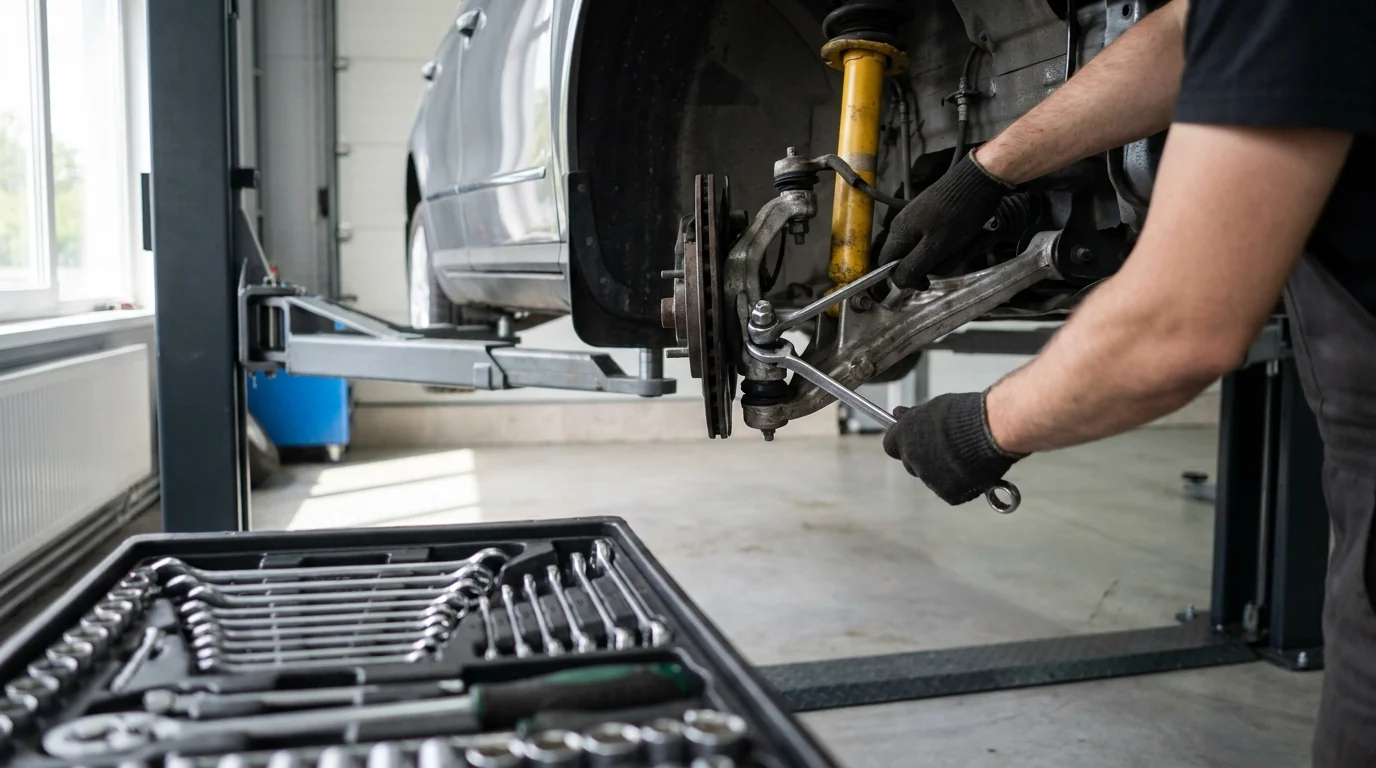
Suspension diagnostics are a mandatory step before a wheel alignment. Performing an alignment on a faulty suspension is money down the drain, as the angles will immediately be thrown off again.
How a Suspension Check is Performed at a Service Center: From the Lift to a Test Drive
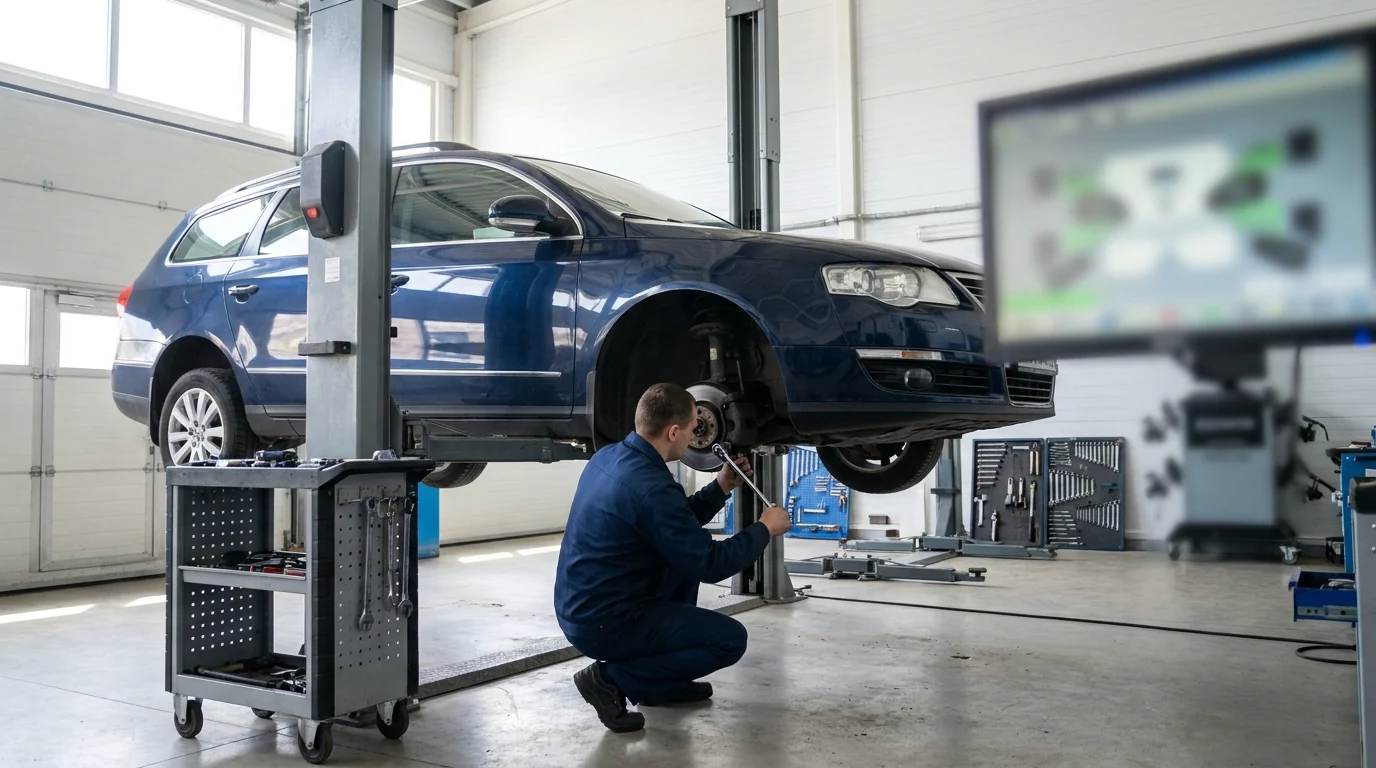
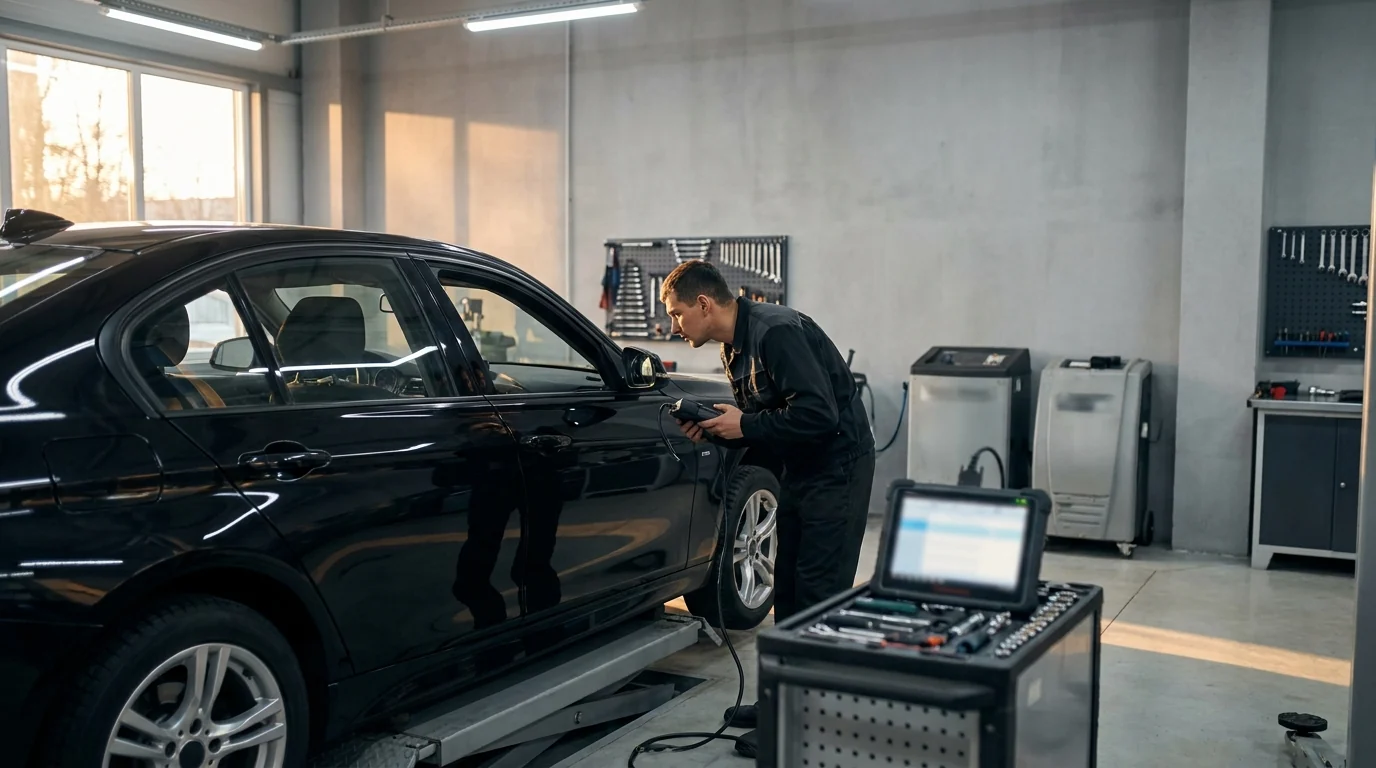
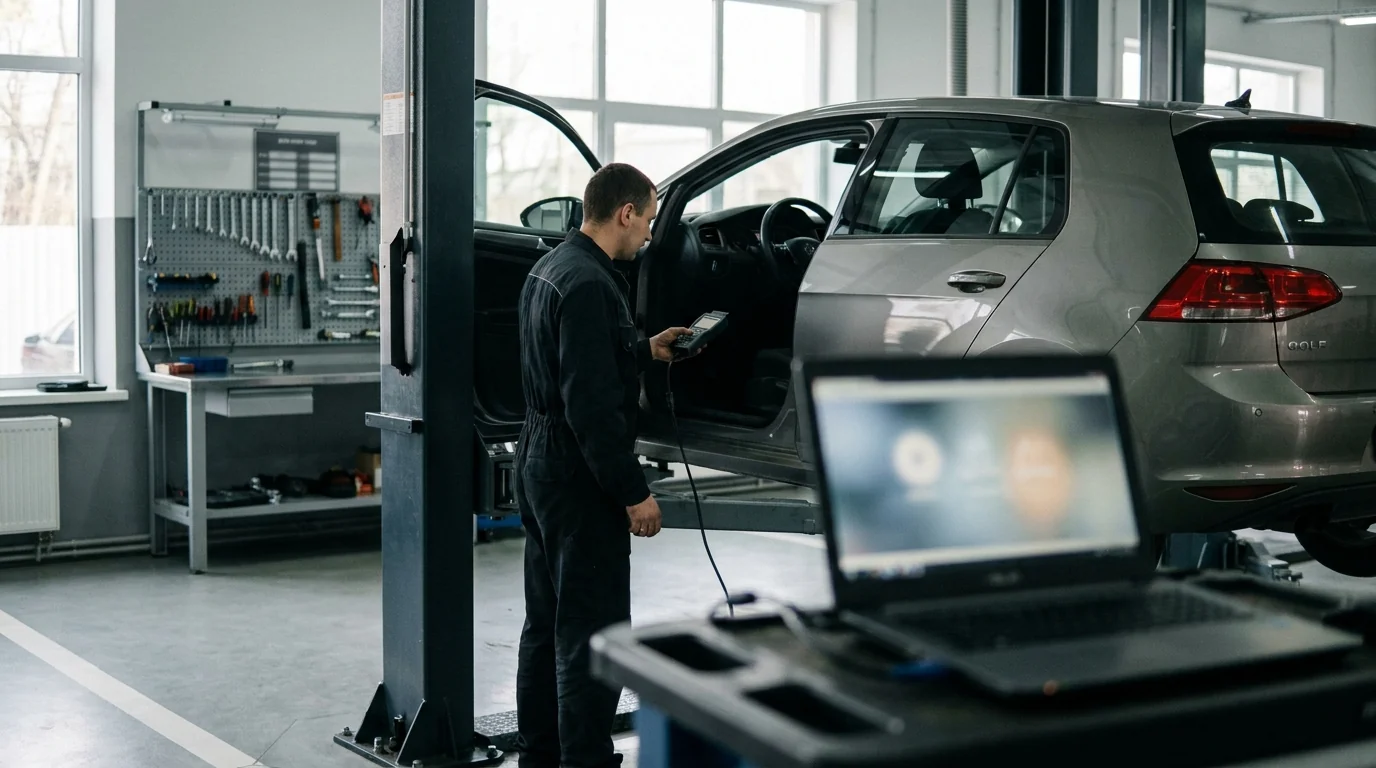
The process of suspension diagnostics is a systematic and thorough inspection that allows us to detect even hidden defects. It all starts with the car being raised on a lift to provide full access to all suspension components. The wheels are left hanging freely.
First, the mechanic performs a visual inspection. They check the integrity of the dust boots (rubber covers) on the ball joints, tie rod ends, and CV joints. Cracks or tears in them are a death sentence for the part, as dirt and water get inside and quickly destroy the mechanism. The shock absorbers are also inspected for oil leaks, and the control arm bushings for cracks and rubber separation.
Next comes the mechanical check. Using a special tool (a pry bar), the mechanic checks for play in every joint: ball joints, control arms, stabilizer links, and steering rods. By rocking the wheels vertically and horizontally, they identify play in the wheel bearings. If the initial inspection doesn't provide a clear answer, especially in the case of an intermittent 'floating' knock, a short test drive with the mechanic may be needed to pinpoint the sound's location. The entire process usually takes about 30 minutes.
The best diagnostic is one that tells you exactly what you *don't* need to spend money on.
Not every knock is a death sentence. Sometimes the cause is simple—a loose stabilizer link, which is an inexpensive fix. We'll never upsell you on replacing entire assemblies if a simple repair will do.
What You Get After the Inspection: An Honest Worklist with No 'Just in Case' Repairs
The result of the diagnostic is not just a verbal verdict, but a detailed defect report—a document that records the condition of key suspension components. Our main principle is maximum transparency and honesty. We will never advise you to replace something that can still work just to increase the bill.
In our list of recommendations, we always divide faults into three categories. The first is 'Critical, repair immediately.' This includes problems that directly affect driving safety, such as a ball joint with excessive play (risk of the wheel detaching) or a worn wheel bearing (risk of the wheel seizing). The second category is 'Recommended.' These are parts that already show significant wear but do not yet pose a direct threat, like shock absorbers that have started to leak or control arm bushings with deep cracks. Their replacement can be postponed, but should be planned for the near future. The third is 'Normal.' These are components that require no intervention.
This approach allows you to make informed decisions and plan your budget for suspension repair. A typical situation faced at almost every service center: a client was advised at another shop to replace several suspension components 'just in case,' when the real cause of a knock is often just one specific worn part, like a stabilizer bushing. This is precisely why a detailed defect report with categorized recommendations is necessary—to replace what is actually faulty, not everything at once.
How Much Does a Suspension Diagnostic Cost in Kyiv at 12 Tiraspolskaya Street?
The base cost for a suspension diagnostic at єМеханік starts from 700 ₴. If you decide to have the repairs done with us immediately after the inspection, the cost of the diagnostic itself is often credited towards the total labor cost—meaning you effectively pay only for the repair, not for the inspection and repair separately.
The procedure itself usually takes 20 to 40 minutes, depending on the car's make and the number of components needing attention. More complex cases—for example, a 'floating' knock that is difficult to locate without a test drive—may take longer. The mechanic will always inform you in advance if the inspection needs to be extended.
Diagnostics should be planned not only when symptoms appear. A regular preventive suspension check is useful after hitting a deep pothole or a hard curb impact, as well as before a long trip or after a long winter of driving on broken roads—this type of load is what wears out control arm bushings and ball joints the fastest.
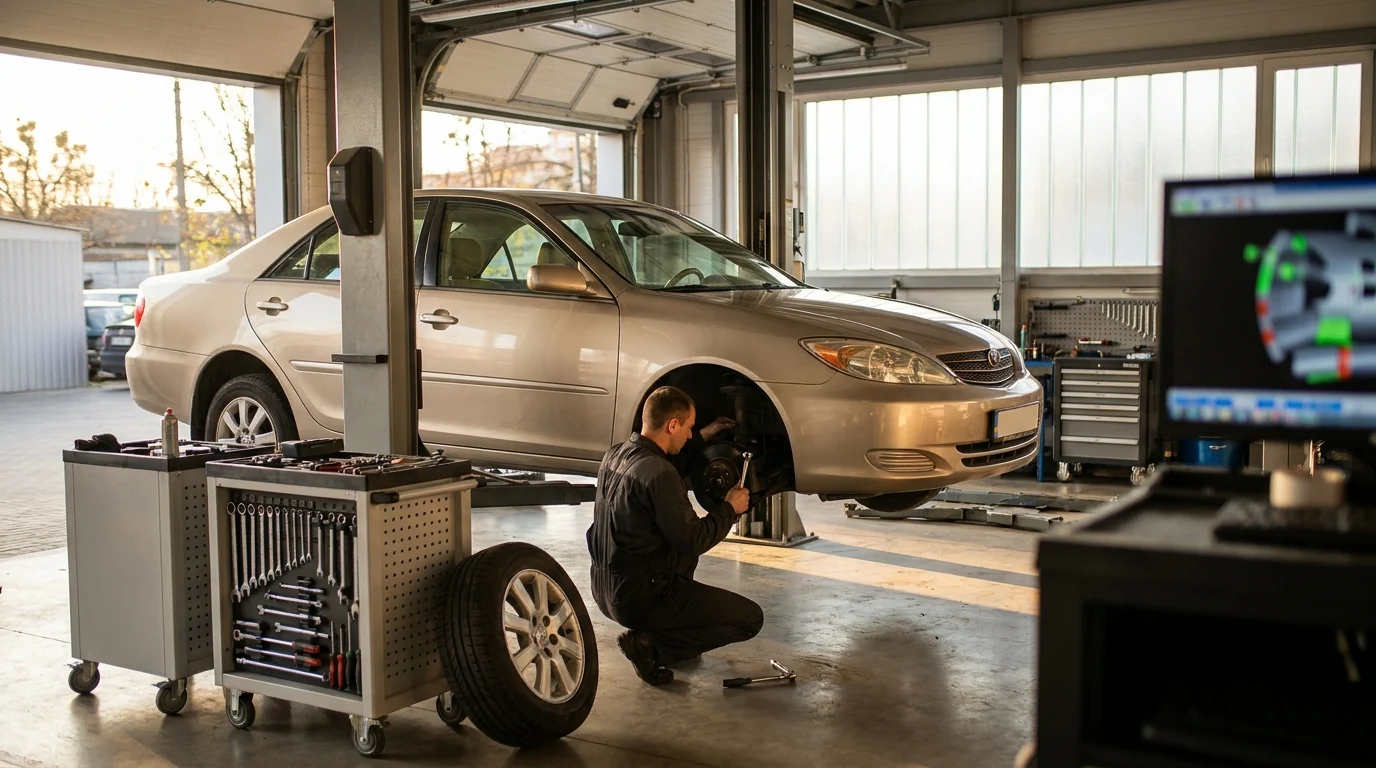
Another convenient time for a diagnostic is during a seasonal tire change. When the wheels are already off for the tire service, it's easier for the mechanic to perform a full visual inspection of all suspension components without spending extra time on wheel removal. Therefore, combining these two procedures in one visit often saves you time.
Why Suspension Diagnostics Come Before a Wheel Alignment
This is one of the most important nuances that is often overlooked. Performing a wheel alignment on a car with a worn-out suspension is pointless: if there is play in the control arms, ball joints, or bushings, the angles set on the alignment rack will simply 'drift' after a few hundred kilometers, or even right after the first serious bump in the road.
Therefore, the correct sequence of actions is always: first, a suspension diagnostic; if necessary, repair of worn components; and only after that, adjusting the wheel alignment angles. If you book an alignment and the mechanic discovers play in the suspension during the pre-check, an honest service center will warn you about this before starting the adjustment, rather than setting the angles perfectly only for them to 'drift' again in a few days due to an unrelated issue.
By the way, the frequency of geometry adjustments is a separate topic: in our guide on how often you should get a wheel alignment, we explain in detail how often to check the angles and what factors influence this. If you are planning both procedures—a suspension diagnostic and a wheel alignment—it's best to mention this when booking your appointment so the service center can allocate enough time for both.
The Most Common Suspension Faults and Their Typical Causes
Shock absorbers dampen the body's oscillations after hitting bumps. Their typical lifespan depends on road quality and driving style—they wear out faster on broken pavement. Signs of a faulty shock absorber include oil leaks on its body, excessive 'bouncing' of the car after a pothole, and an increased braking distance, as the wheel has poorer contact with the road.
Control arm bushings (silentblocks) are rubber-metal sleeves that connect the suspension arms to the body and dampen vibrations. Over time, the rubber in them cracks or separates, creating play, which the driver feels as a knock or 'softness' in the steering over bumps. Ball joints connect the control arm to the wheel hub and allow the wheel to turn; a worn ball joint is one of the most dangerous faults, as extreme wear can lead to the joint's pin popping out of its socket while driving.
Stabilizer links and wheel bearings are two other common sources of knocks and hums. Stabilizer links wear out relatively quickly and produce a characteristic dull knock over small bumps; a wheel bearing, in contrast, usually manifests as a monotonous hum that changes with speed and sometimes intensifies in turns due to the redistribution of load on the wheel.
What Cars We Work With
The lifts and tools at єМеханік are designed to work with a wide range of models: BMW, Mercedes, Audi, Volkswagen, Toyota, Skoda, Lexus, Land Rover, Volvo, Porsche, MINI, Honda, Nissan, Ford, Hyundai, Subaru, Mitsubishi, Renault, Peugeot, Infiniti, Chevrolet, Seat, Mazda, Kia. Each of these makes has its own suspension design—some have a multi-link rear axle, others have air suspension on premium models—and this affects how many components physically need to be checked on the lift.
Cars with air suspension (certain models of Mercedes, Land Rover, Audi, Porsche) require extra attention: in addition to mechanical elements (control arms, bushings), the condition of the air springs and compressor is inspected for air leaks. This does not change the base cost of the diagnostic, but the inspection itself may take slightly longer due to the additional components.
If your suspension has been previously repaired elsewhere, during our diagnostic we also pay attention to the quality of the previously installed parts—whether they are original or aftermarket, and whether they might need premature replacement due to poor quality.
What You Can Check Yourself Between Visits to the Service Center
You can't perform a full diagnostic for play on a lift at home, but a driver can monitor a few simple things. Once a season, it's worth inspecting your tire tread: uneven wear on the edge or in 'patches' is a reason to book a suspension inspection, even if you haven't heard any strange noises yet.
Second, listen to your car at low speed on an uneven surface, like in a courtyard. It's easier to remember and describe a single dull knock from a specific corner of the car to the mechanic ('it knocks in the front right over bumps') than to try to recreate the sensation at the service center. This significantly speeds up problem localization during the inspection.
Third, pay attention to any change in steering behavior: if it has become 'heavier' or, conversely, excessive play has appeared before the wheels start to turn, this is also a signal worth noting, even if the suspension isn't making any noises yet. Make a note of the speed and conditions under which the symptom is most pronounced—this detail greatly helps the mechanic to reproduce and locate the problem faster on the lift. Such notes save inspection time and increase the chance of finding the cause on the first try, without a repeat visit.
In a Nutshell
A suspension diagnostic is a relatively quick (20-40 minutes) and inexpensive (from 700 ₴) procedure that accurately identifies the source of knocks and allows you to plan repairs, separating critical faults from those that can wait. It should always precede a wheel alignment; otherwise, the set angles will quickly be thrown off again. This is your key to safety and a way to avoid unnecessary repair costs. If you feel there's a problem with your suspension, don't delay—check for available times and book an inspection.
Frequently asked questions
Book in a minute —
Leave your number and we'll call back. Or share the details so the technician can prepare.
Book nowWhat clients say.
Honest Google reviews. Unedited.