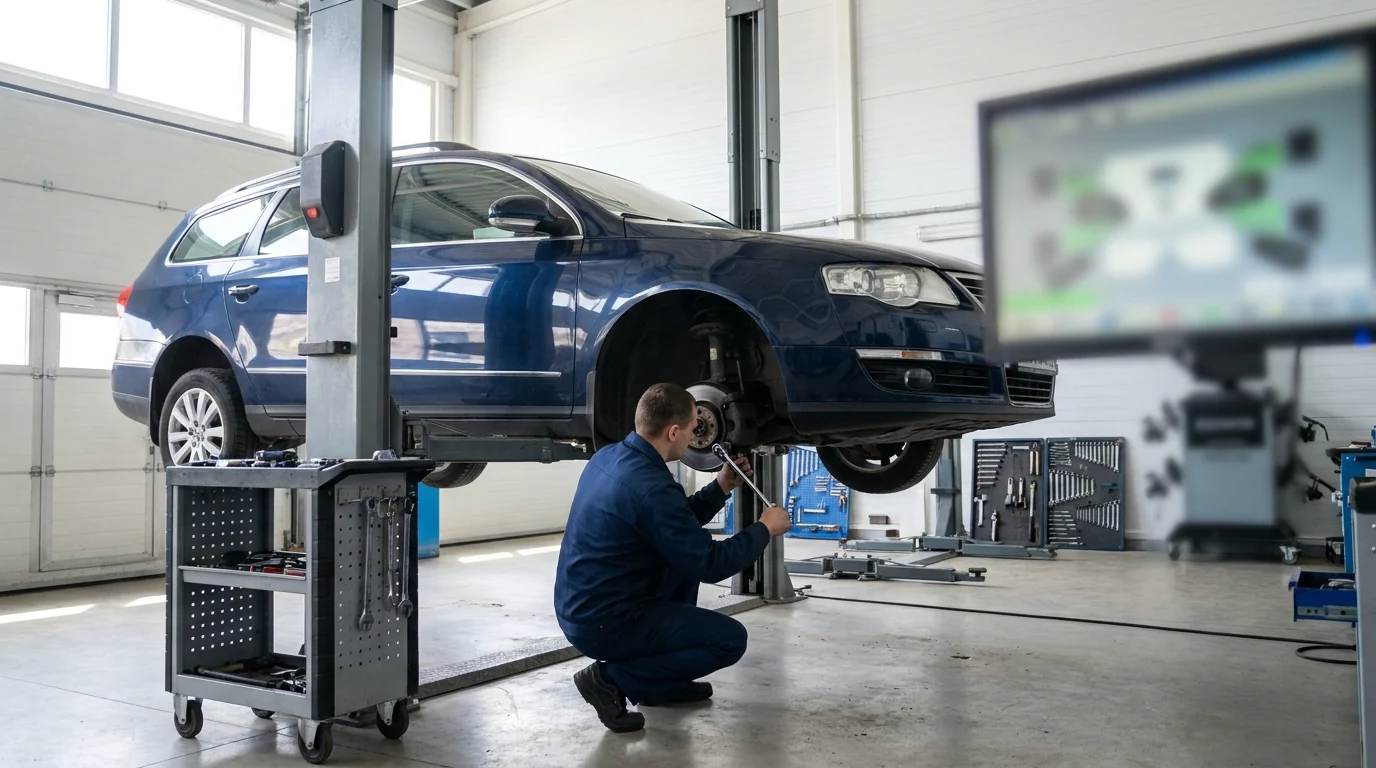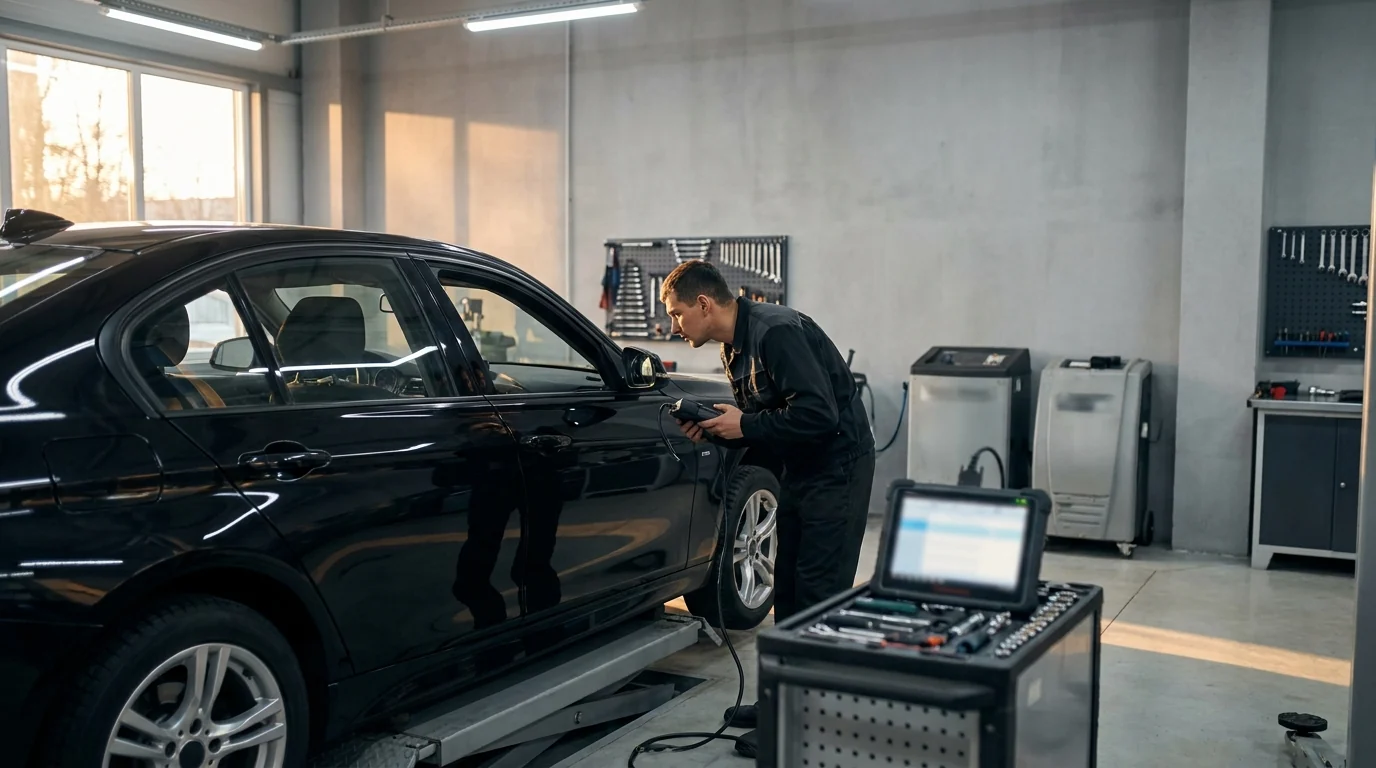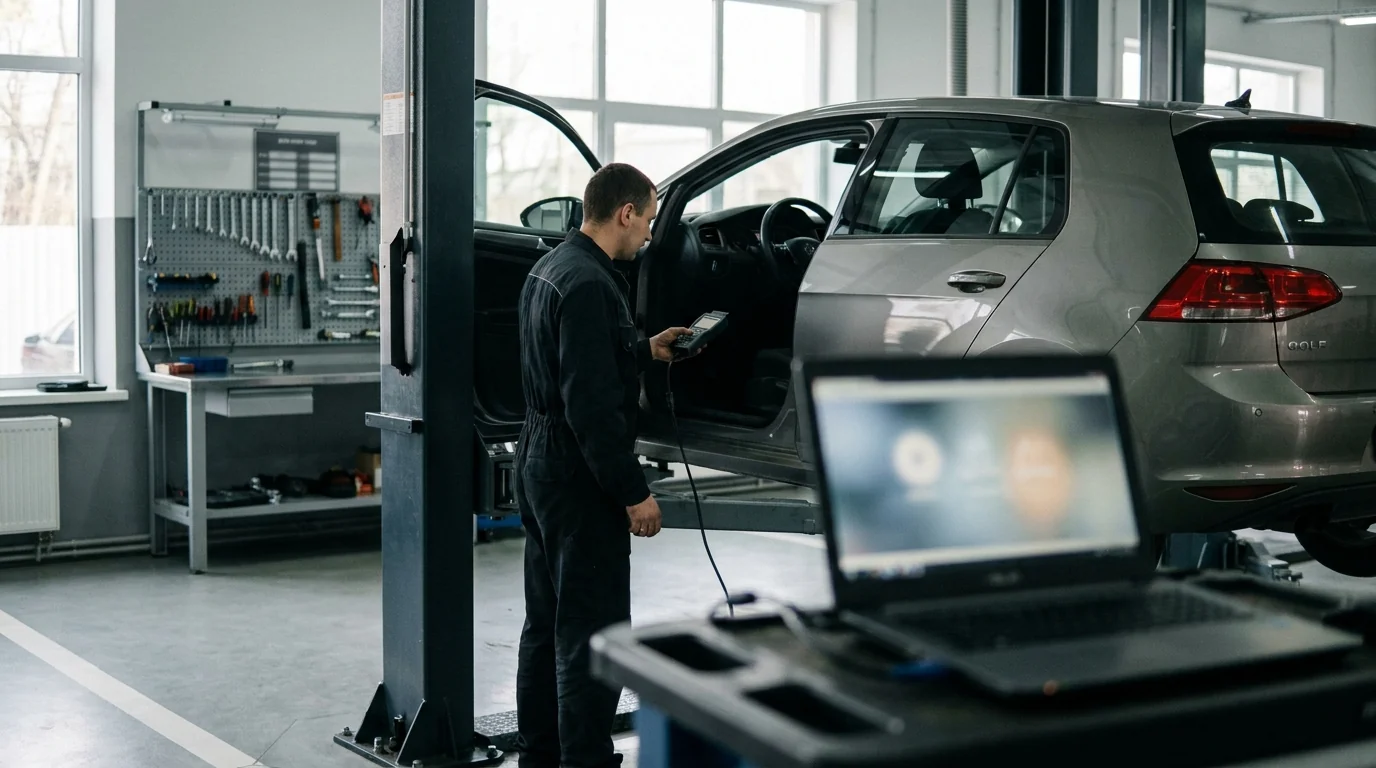
Computer diagnostics involves reading error codes from your car's electronic control units. It's the first and fastest step to understanding why a light has come on your dashboard or why the car is behaving strangely. At eMechanic, located at Tyraspilska, 12, this procedure costs 1 000 ₴ and takes about 30 minutes. It's important to understand that a scanner doesn't provide a ready-made solution; it only points to the problem area—be it the engine, transmission, ABS, airbags, or another system. Our job is to correctly interpret this data, find the root cause of the malfunction, and propose a specific action plan so we don't replace working parts at random.
What a Scanner Actually Shows and What Not to Expect from It
The diagnostic scanner connects to your car's standard OBD-II (On-Board Diagnostics) port and essentially communicates with its 'brain.' It can read two types of information. The first is Diagnostic Trouble Codes (DTCs). These can be active (the problem exists right now) or stored (the problem occurred previously but may not be present now). Each code points to a specific failure, such as 'incorrect signal from oxygen sensor' or 'misfire in cylinder three.'
The second type of information is real-time data (Live Data). This is a stream of readings from dozens of sensors: coolant temperature, engine RPM, ignition timing, fuel rail pressure, injector performance, and much more. Analyzing these parameters allows an experienced technician to spot inconsistencies that haven't yet triggered an error code.
What you shouldn't expect from a scanner is magic. It won't say, 'replace the spark plug in cylinder two.' It will report a misfire in that cylinder. The cause could be not only the spark plug but also the ignition coil, the fuel injector, a wiring issue, or even low compression. Therefore, computer diagnostics is not a final verdict, but rather the collection of evidence. The mechanic's job is to use this evidence to conduct further, more in-depth checks and pinpoint the faulty part.
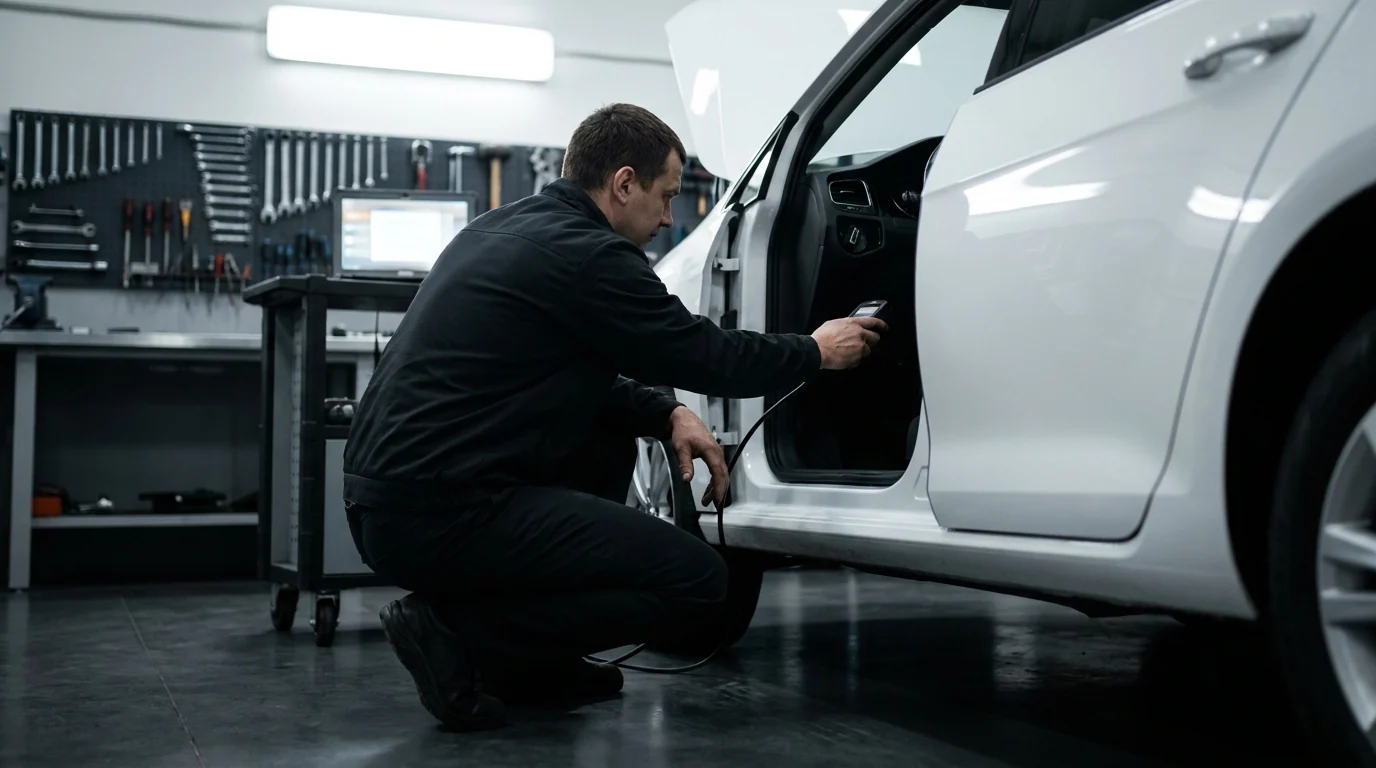
The 'Check Engine' light is not just a light. Ignoring it can lead to more serious and expensive breakdowns, such as a failed catalytic converter.
When to Get a Computer Diagnostic: Key Symptoms
The most obvious reason is the appearance of warning lights on the dashboard. The most famous of these is the 'Check Engine' light. But you shouldn't ignore other lights either: ABS, ESP (Electronic Stability Program), SRS (airbags), or the tire pressure indicator. Each one signals a fault in its respective system.
However, there are also less obvious symptoms that are a direct indication for a check-up:
Changes in engine performance: The car has become sluggish, lost power, jerks during acceleration, the RPMs fluctuate at idle, or the engine stalls.
Increased fuel consumption: If you notice you're having to refuel much more often with the same driving style, it could be due to malfunctioning sensors.
Automatic transmission problems: Jerks, delays when shifting gears, or the transmission going into limp mode.
Before buying a used car: This is a mandatory step. A scan will reveal hidden problems and signs of a rolled-back odometer. It's a small expense compared to potential repairs. We covered the comprehensive inspection in more detail in our guide, 'Why a pre-purchase inspection is necessary'.
After any accident: Even if the damage seems minimal, it's important to check the safety systems (airbags, seatbelt pretensioners), as their sensors could have been damaged.
A scanner doesn't fix a car. It just provides the map; the experienced mechanic charts the course.
Cheap error code reading at garage shops often ends with replacing perfectly good parts. You're not paying for plugging in a scanner; you're paying for the correct interpretation of its data. The cheapest repair is the one you didn't have to do unnecessarily.
From Error Code to Repair: How We Interpret the Results
The diagnostic process at eMechanic is a clear algorithm aimed not just at telling you an error code, but at explaining what it means and what to do about it. First, we perform a full scan of all available electronic modules. This is important because a problem in one system, for example, the brake system (an ABS sensor), can cause errors in other related systems (stability control, transmission).
After getting the list of codes, the technician analyzes them together. For example, a lean fuel mixture error could be caused by a faulty oxygen sensor, an air leak in the intake manifold, or low fuel pressure. Simply replacing the sensor is a game of roulette. Instead, we check related parameters: we look at fuel trim values and use a smoke machine to check for intake leaks.
Only after localizing the problem do we propose a repair plan. If the error points to a complex engine issue, the next step might be an in-depth engine diagnostics. If the problem is in the electrical circuits, an auto electrician will take over. You receive a clear explanation: what broke, why it happened, and how to fix it reliably. We don't start any work without your approval.
How Much Does a Computer Diagnostic Cost in Kyiv at Tyraspilska, 12
A full scan of all your car's electronic modules at our service center costs 1 000 ₴. This price includes reading codes from all available systems—engine, transmission, ABS, SRS, climate control, and body electronics—not just checking a single light on the dashboard.
The standard procedure of reading and interpreting codes takes about 30 minutes. If the case is complex and requires additional tests—for example, checking fuel trims in real-time during a test drive—we will inform you in advance before such a check begins.
If you decide to fix the malfunction with us immediately after the diagnostics, the cost of the scan is often credited towards the total repair bill. This applies to both electrical work and mechanical interventions where the cause of the error code turns out to be not in the electronics, but, for example, in a worn-out sensor or a vacuum hose.
What Car Brands We Work With
Our equipment allows us to perform computer diagnostics on most popular brands: BMW, Mercedes, Audi, Volkswagen, Toyota, Skoda, Lexus, Land Rover, Volvo, Porsche, MINI, Honda, Nissan, Ford, Hyundai, Subaru, Mitsubishi, Renault, Peugeot, Infiniti, Chevrolet, Seat, Mazda, Kia. We read data from all major systems of these cars, including the premium segment, where there are significantly more electronic control units than in budget models.
On premium German brands (BMW, Mercedes, Audi), the number of control units is particularly large—there are separate modules for climate, suspension, lighting, and multimedia. A full scan on such cars requires more attention during analysis, as a single physical fault (like a voltage drop in the electrical system) can simultaneously trigger several formally unrelated codes in different systems.
If you have a car brand that is rare for the Ukrainian market, it's best to confirm equipment compatibility when booking an appointment. In the vast majority of cases, the standard OBD-II protocol allows for a basic scan, while deeper work with specific modules depends on the availability of the appropriate software.
Hybrid and electric models (for example, certain versions of Toyota, Hyundai, or Ford) have additional control units—a battery controller, an inverter, and power electronics. Computer diagnostics for such cars also cover these systems, as they are often the ones signaling a problem on the dashboard in hybrids, rather than the classic internal combustion engine.
Why an Intermittent Error Is No Reason to Ignore the Problem
It's a typical situation: the Check Engine light comes on for a few days, then turns off by itself, and the driver decides the problem 'fixed itself.' In reality, the stored code doesn't disappear from the control unit's memory. The light goes off after a manufacturer-set number of 'clean' engine start cycles without the error recurring, not because the cause has been eliminated.
Such intermittent errors are often more difficult to diagnose than persistent ones: the fault may only appear at a certain engine temperature, humidity, or load. In such cases, a scanner with stored codes and Live Data at the moment the problem occurs is the only way to understand what was happening with the engine at that time, even if everything seems normal now.
That's why we always check not only active codes but also stored codes with Freeze Frame data—a snapshot of sensor readings at the exact moment the error occurred. This allows us to recreate the conditions under which the failure happened, even if the indicator is no longer lit at the time of the visit to the service center. It is often these stored codes that become the key to diagnosing 'ghost' faults that are impossible to catch live during a regular inspection.
Computer Diagnostics and Mechanical Failures: Where's the Line
It's important to understand that a scanner only sees what the electronic sensors measure. If the cause of the problem is purely mechanical—for example, a knocking sound in the suspension or worn brake pads—computer diagnostics will most often show no errors, as these components do not have their own electronic sensors to report mechanical wear.
This is why we clarify the nature of the symptom when you bring your car in. If it's a warning light on the dashboard or strange behavior from the engine/transmission, we start with a scan. If it's a knock, vibration, or the car pulling to one side on a straight road, it's more rational to book a suspension diagnostic right away, and only use a computer scan if needed as an additional check.
There are also mixed cases: a mechanical fault eventually triggers an electronic error. For example, a severe wheel misalignment due to a worn-out suspension can lead to uneven rotation of the ABS sensors and trigger a corresponding code. In this case, the scanner will point us in the right direction, but the ultimate cause is found on the lift, not on a laptop screen. Therefore, in ambiguous cases, we openly tell you which next step is more logical—another scan or a mechanical inspection—and we don't insist on a paid repeat diagnostic without a valid reason.
Which Control Units We Check in a Single Session
A 'full scan' at our service center means checking all available modules, not just the engine. This includes the Engine Control Unit (ECU)—the most common source of Check Engine codes; the Transmission Control Unit (TCU)—for jerks and shifting delays; the ABS/ESP module—for stability control and the anti-lock braking system; the SRS module—for airbags and seatbelt pretensioners; as well as the climate control and body electronics modules (central locking, power windows, lighting), which can also have their own error codes.
The reason for checking everything at once, rather than just the system with the lit indicator, is simple: modern control units exchange data with each other over an internal network (the CAN bus), and a failure in one node often triggers an error in another. Checking only one module can give an incomplete picture and lead to replacing a working part instead of the actual faulty one.
We present the results of this full scan to you as a clear list: which system, what code, what it means, and how critical it is. This is the same transparency we apply to suspension diagnostics—no 'guesswork' decisions without explaining the reason. If a code relates to a system that doesn't affect safety or handling (for example, a minor body electronics error), we will tell you directly that it can be postponed, rather than artificially inflating the list of urgent work.
The Bottom Line
Computer diagnostics is a quick (about 30 minutes) and affordable (1 000 ₴) way to determine the direction for troubleshooting in modern cars. It doesn't replace the experience of a technician but gives them a tool to accurately pinpoint the cause of a problem, saving you money on replacing perfectly good parts. It's also important to remember the method's limitations: a scanner sees mechanical faults only indirectly. If you notice alarming symptoms, don't postpone a visit—book a check-up.
Frequently asked questions
Book in a minute —
Leave your number and we'll call back. Or share the details so the technician can prepare.
Book nowWhat clients say.
Honest Google reviews. Unedited.